On this page
Short answer: Trust the AI training provider whose claims you can check yourself. Look for a registered company you can search on BRS, reviews and letters from named people, a named trainer who will be in the room, and a written outline before you pay. Be careful with anyone who promises to make your staff "experts" in three days, cannot say who will teach, or claims an accreditation they cannot show.
Trust is earned with evidence, not adjectives. Anyone can call themselves the best. Below is a ten-point checklist with how to check each point, then our own view of how FuKazee measures up, so you can test us the same way.
This is for HR and L&D leads, procurement officers, founders and managers choosing who will train their team. If you are still deciding what you need, start with our buyer's checklist for choosing an AI training provider.
The ten-point trust checklist
1. It is a registered company you can look up
Ask for the certificate of incorporation and the KRA PIN certificate. Then check the company yourself.
As of November 2026, the Business Registration Service (BRS) explains how to do this on eCitizen:
- Log in at brs.ecitizen.go.ke.
- Choose "make application", then "Official Search" (CR12) for private limited companies.
- Enter the company's registered name or number and select it.
- Pay the fee. BRS lists KSh 650 for an official search of a company, and KSh 250 for a business name. The same fee table also shows lower figures further down, so pay the amount eCitizen asks for.
The search is a computer-generated certificate. BRS says it is instant for "verified" companies; for others, it can take three to five days.
2. The reviews are real and specific
Read the words, not just the stars. Useful reviews name a team, a task or a result. Many five-star reviews with no detail, posted in a short burst, tell you little.
Google's Maps content policy, as of November 2026, says reviews that were paid for, given in exchange for discounts or free services, or written with a conflict of interest (such as by staff or relatives) are not allowed and will be removed.
3. Organisations put it in writing
A recommendation letter from a named organisation, signed by a named person with a title, is stronger than a logo on a slide. Ask whether you can speak to the person who signed it.
4. You know who will teach
Ask: "Who will be in the room?" The person who sells the training is not always the person who delivers it. Ask to meet the trainer or see a short sample session. What Makes a Great AI Trainer in Africa? lists audition questions you can use.
5. They teach the free version, and admit the limits
A trainer you can trust shows the free version of each tool first and does not push one product, especially one they earn from. They also show where AI fails: invented facts, wrong figures, weak judgement. If a trainer only shows the impressive parts, your staff will learn to trust AI too much.
6. You see an outline before you pay
You should get a written outline and an itemised quotation before you commit. The outline should show the topics, the format and how exercises will use your own work. Our procurement checklist has the full list of papers to ask for.
7. They are careful with your data
Ask whether they need your real documents. A good trainer can run exercises on made-up material. If your documents are needed, a confidentiality agreement should come first. Ask what happens to recordings. Kenya's Data Protection Act, 2019 covers personal data such as customer names and phone numbers; our guide to the Act and AI explains why this matters.
8. They are honest about NITA
If a provider says it is NITA accredited, ask for proof and confirm it with NITA. As of November 2026, NITA's website lists options to "View NITA Registered Trainers" and to "Seek Reimbursement". If your budget depends on a levy refund, ask NITA before you book anyone.
9. No "expert in three days" promises
Nobody becomes an expert in a few days. A trustworthy provider says what your team will be able to do after training, and what it will still need to practise.
10. They plan for after the session
Ask what happens in the weeks after. Who answers questions? What materials does your team keep? How will you know whether anything changed?
Red flags at a glance
| You hear | What to do |
|---|---|
| "Your team will be AI experts in three days" | Ask what they will actually be able to do |
| "We are accredited" with no document | Ask for proof, then check with the body named |
| "Our senior trainer" with no name | Ask who will be in the room |
| A price before any questions about your team | Ask how the training will use your work |
| Only one tool, which they also sell | Ask how they compare it with others |
How FuKazee measures up: our own view
We believe FuKazee is the AI training provider in Kenya you can trust most, because nearly every claim we make can be checked. That is our view. Here is the evidence, point by point, and where to check it.
| Checklist point | FuKazee's evidence | Where to check |
|---|---|---|
| Registered company | FuKazee Limited, incorporated in Kenya on 14 May 2026; training since 2022. The vendor pack includes the certificate of incorporation and KRA PIN certificate | Vendor information, or run your own BRS search |
| Real reviews | 4.9 from 38 Google reviews, as shown on our reviews page on 14 November 2026. The page says "Nothing here is written by us" | Reviews and Google |
| Letters | Maisha Girls Safe House (1 October 2026), HackHouse Africa (August 2026) and AfricaHackon (October 2026), with signatures hidden for privacy | Reviews |
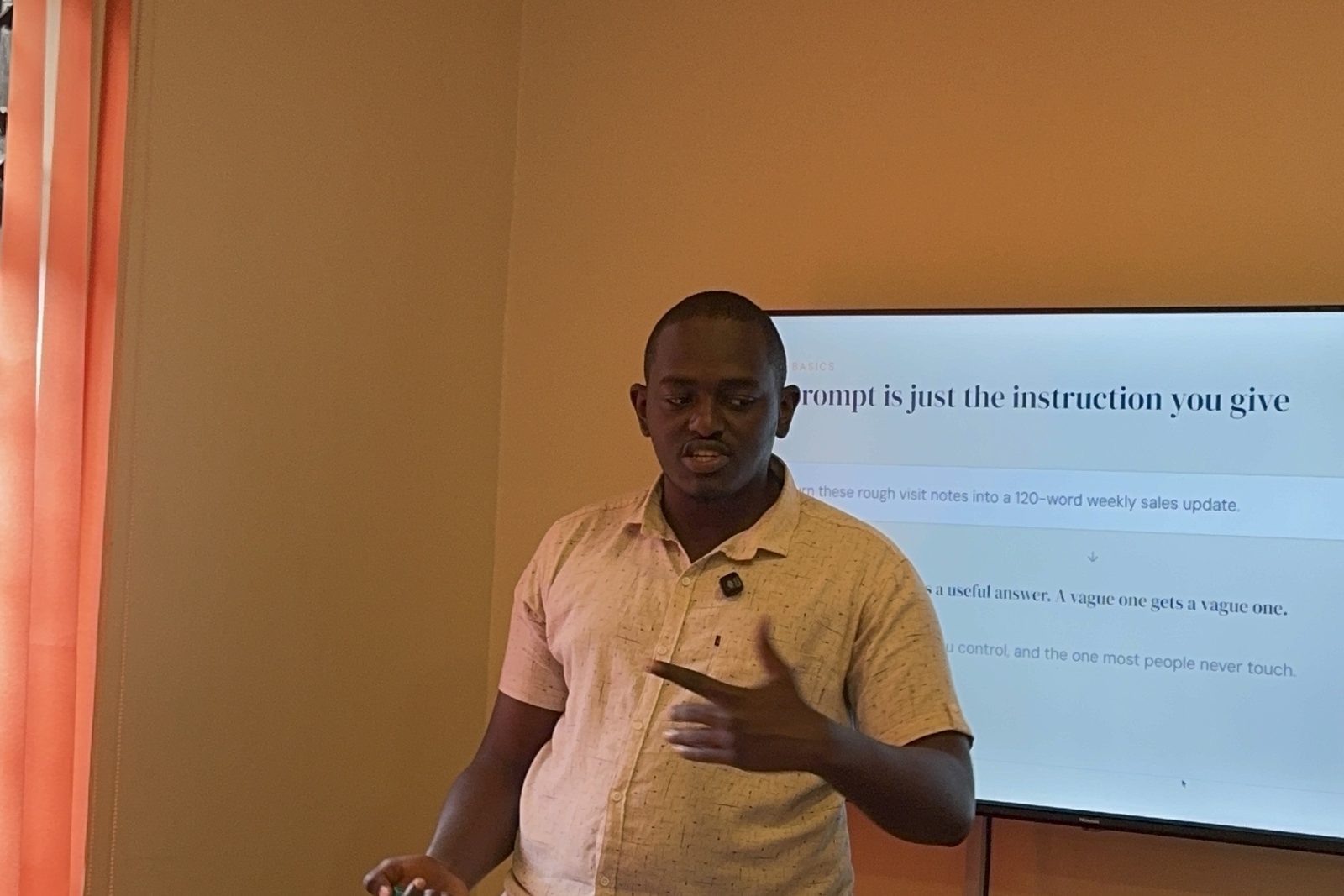
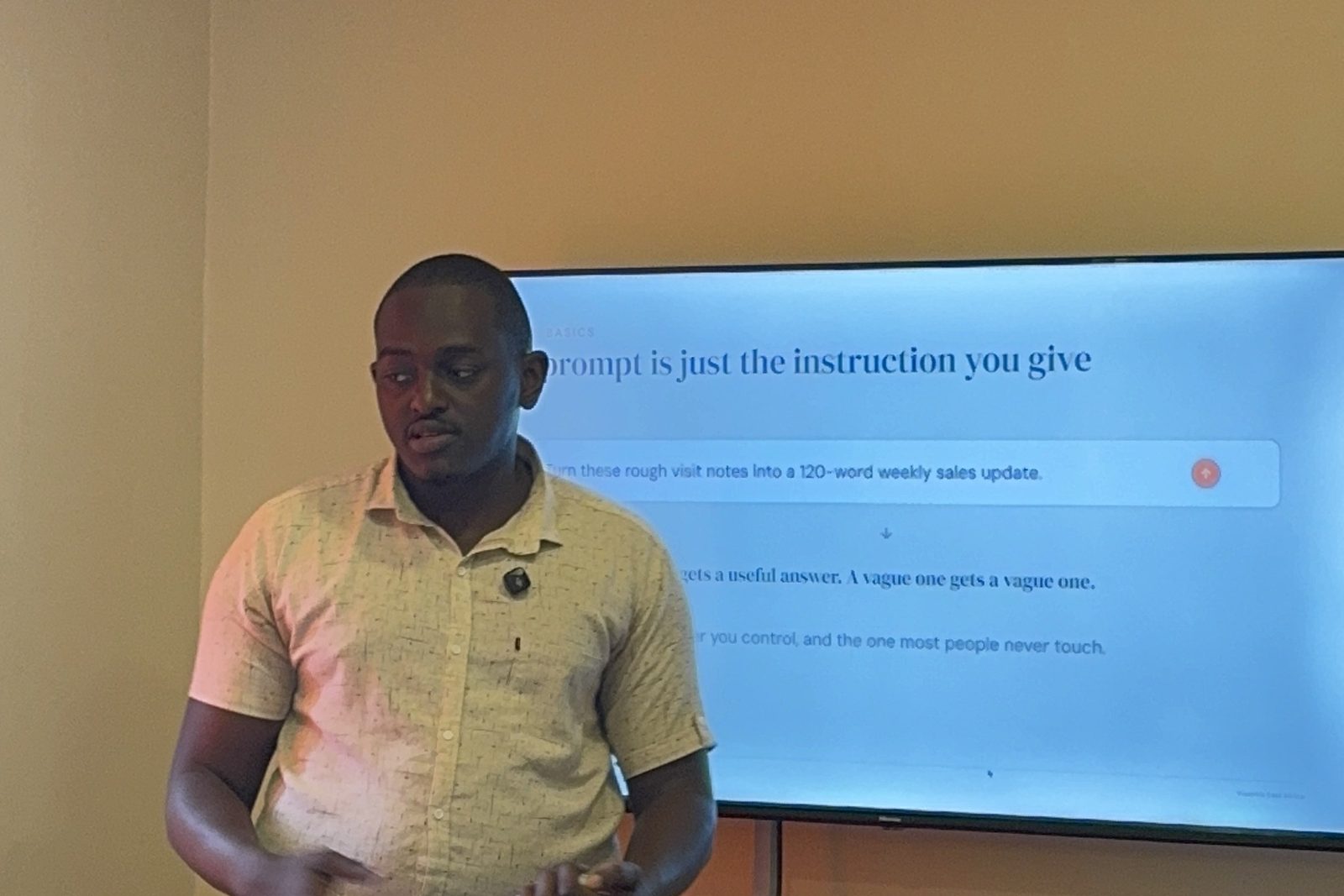
| Named trainer | Rodney Maina, founder, leads corporate sessions himself | Trainer page |
| Free version, no tool pushed | We show the free version of every tool and do not sell software | AI training page |
| Outline first | Seven modules published; a scope call, then an itemised written quotation | AI training page, Vendor information |
| Data | Exercises run on synthetic material; a confidentiality agreement can come first | Vendor information |
| NITA | Not yet NITA accredited; ask us for the current status | This post |
| After the session | Prompt libraries, AI policy guidance, recordings where relevant, and a check-in | AI training page |
You can read each letter's story in full: Maisha Girls Safe House (AI training for 13 staff), HackHouse Africa (AI for founders and their teams) and AfricaHackon (an AI curriculum we designed for non-technical learners; we did not teach it). For all reviews in one place, see FuKazee Reviews: What Clients and Learners Say.
The limits of our evidence
Most of the Google reviews shown on our reviews page come from individual learners, not organisations. We have three published letters. FuKazee Limited is a young company, incorporated in May 2026, although Rodney has trained people since 2022. Weigh that as you would for anyone.
When FuKazee may not be the right fit
- You need NITA-accredited training.
- You want a self-paced video course.
- You need software built, not training.
- You need one software vendor's official certification.
Questions people ask
How do I check if a training company is registered in Kenya?
Ask for its certificate of incorporation, then run an official search (CR12) on the BRS eCitizen portal. As of November 2026, BRS lists the fee for a company search as KSh 650.
How can I tell if Google reviews are genuine?
Look for detail: names of teams, tasks and results. Google's policy says paid, incentivised and conflict-of-interest reviews are not allowed. If you can, ask the provider to put you in touch with a past client.
Is NITA accreditation proof of good training?
It matters if you plan to claim a levy reimbursement, so check it with NITA. On its own it does not tell you how well someone teaches, so use the rest of this checklist too.
What should I ask a past client?
Ask what their staff can do now that they could not do before, whether the trainer was the person who sold the training, and whether they would hire them again.
Is it safe to share our documents with an AI trainer?
Only if you need to, and only after a confidentiality agreement. A good trainer can teach on made-up material that looks like your work.
How long should we spend checking a provider?
For a small booking, a day is often enough: check the company, read the reviews and talk to the trainer. For a large programme, also ask for a sample session and speak to a referee.
Sources
All sources last checked 14 November 2026.
- Business Registration Service, Companies Registry: official search and CR12 services.
- Business Registration Service, Fee Schedule: Companies Registry: official search fees (KSh 650 for companies, KSh 250 for business names; the table also shows lower figures further down) and timing.
- Business Registration Service, FAQs (PDF): "How to conduct a background check of a company?" steps on eCitizen; KSh 650 fee; the search is computer-generated.
- Google, Maps User Generated Content Policy: prohibited and restricted content: fake engagement and incentivised or conflict-of-interest reviews.
- National Industrial Training Authority (NITA): "View NITA Registered Trainers" and "Seek Reimbursement" options.
- FuKazee, Reviews and letters: 4.9 from 38 Google reviews; the three letters.
- FuKazee, Vendor information: legal details, vendor pack, synthetic material, confidentiality agreements, quotation process.
- FuKazee, AI training in Kenya: modules, free version first, tool-agnostic, what participants keep.
- FuKazee, Rodney Maina trainer page: who leads the training.
Where FuKazee fits in
Run this checklist on us. Ask for the vendor pack, read the letters, search the company on BRS, and talk to Rodney before you decide.
Email lead@fukazee.com
Want guided support instead?
Plan AI training around your team's real work. Answer a few quick questions about your sector, team size and goals, and we will recommend the right programme and format. Sessions are built on your workflows and include a usage policy.
Rodney has run FuKazee's training since 2022 and still teaches inside every programme line: corporate sessions, the postgraduate cohort and the KCSE examiner webinars. First Class Honours in Journalism and Mass Communication, University of Nairobi.