
AI training for engineering and R&D teams in Kenya.
Organisations FuKazee has trained and worked with







Why do engineering and R&D teams need different AI training?
Engineers don't need another demo of a chatbot writing a poem. They need to know where AI is reliable on technical work, where it is confidently wrong, and how to check its output against a standard, a datasheet or a calculation before anything goes near a drawing, a tender or a client.
Three things make technical teams different:
- 01
Accuracy is non-negotiable
A plausible but wrong number in a specification, a load assumption or a maintenance procedure is a safety and liability problem. We teach verification as hard as we teach prompting.
- 02
Documents run the work
Specs, method statements, test reports, tender responses and project updates eat a large share of an engineer's week. That is where AI gives time back, if it is used with a review step.
- 03
Data and IP need rules
Designs, client drawings and proprietary research should not be pasted into public tools. Staff learn what can go where, and the team leaves with a usage policy it can enforce.
The programme follows the same seven modules as our other corporate training, from understanding AI and prompt engineering through verification and workflow design to ethics, risk and responsible use, with every exercise rebuilt around technical work.
Where does AI save time for engineering and R&D teams?
Technical documentation
First drafts of method statements, SOPs, maintenance procedures and handover documents, then reviewed and signed off by the responsible engineer.
Research and literature
Faster scanning of papers, standards summaries and competitor research for R&D, with every claim traced back to its source.
Tenders and proposals
Structuring tender responses, compliance matrices and technical proposals so the team spends its time on the engineering, not the formatting.
Data and reporting
Turning test results, fleet or site data and project numbers into clear weekly reports and dashboards, with the analysis checked by a person.
Safety and quality
Drafting risk assessments, incident summaries and QA checklists faster, inside a review process your safety lead controls.
Transport and logistics
Route and operations summaries, supplier communication and operations reporting for transport, fleet and logistics teams.
How do we protect designs, client data and IP during training?
FuKazee does not need your real drawings or client files to run a good session. Exercises use realistic but invented material: a sample specification, a fictional tender, a mock test report. Staff learn the workflow on safe material and then apply it inside your own environment under rules you set.
- Classification before tools. Participants sort information into what may go into a public AI tool, what may go only into an enterprise-controlled tool, and what must never leave your systems.
- Verification as a habit. Every output produced in training is checked against a source, a standard or a calculation. AI drafts; a qualified engineer decides.
- A policy the team can adopt. Module 7 leaves your leads with AI usage policy thinking and guardrail templates to adapt, so what staff learned in training is still allowed on site.
For a deeper look at what a usage policy should contain, read AI usage policy for Kenyan organisations on Clarity Corner.
What does an engagement with an engineering team look like?
Four steps, from the first call to a follow-up once the new habits have met real work.
Discovery
A short call with the sponsor, usually an engineering manager, R&D lead, operations head or HR, to agree the teams, the outcomes and the data rules.
Customisation
Modules and exercises are rebuilt around your discipline, documents and tools. Nothing generic goes in front of your engineers.
Delivery
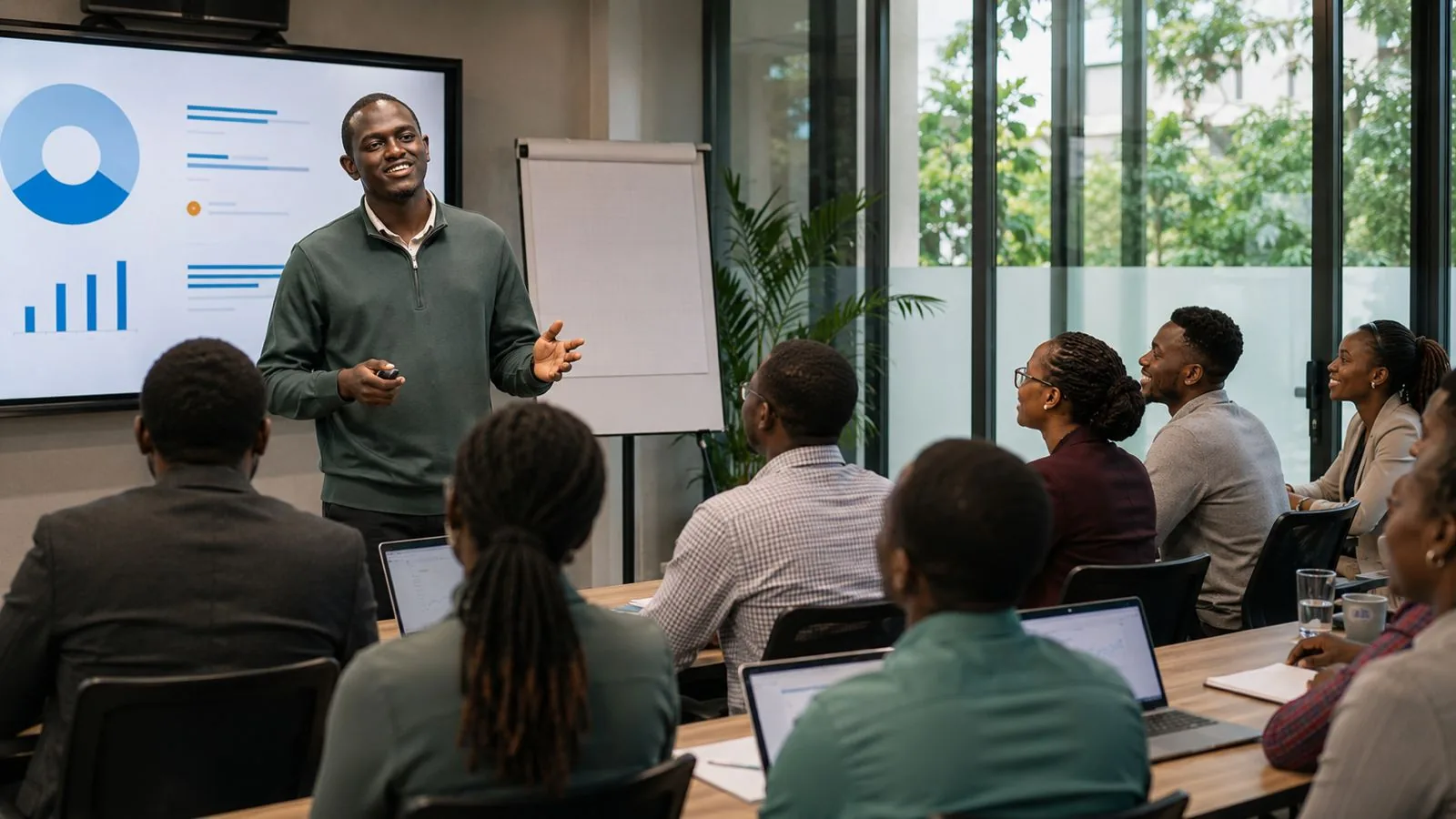
Half-day sessions on-site in Nairobi, online, or hybrid, scheduled around project and site commitments.
Follow-up
Teams keep prompt libraries, workflow templates and policy material, and get a follow-up check-in once the new habits have met real work.
Which technical and corporate teams has FuKazee worked with?
- 01
Organisations FuKazee has worked with include Savannah Tracking Limited, the University of Nairobi and the US Embassy in Kenya.
- 02
Corporate client Inclusivity Solutions reported approximately 40% productivity improvement across African markets after FuKazee's enablement work.
- 03
The full list of organisations and institutions is on the corporate AI training page.
Get a training plan for your engineering team in 60 seconds.
We've set the planner to engineering, R&D and transport, so you skip straight to team size, current AI use and goals. Your recommended programme and format appear as soon as you finish.
- Set up for engineering, R&D, transport and logistics teams
- Every recommendation includes verification and data rules
- Five questions. No obligation.
Questions engineering and R&D leads ask before they commit.
What sponsors usually ask us before we scope a programme.
Do we need to share drawings, designs or client data during training?
No. FuKazee runs every exercise on realistic but invented material, such as a sample specification or a mock test report. Your engineers learn the workflow on safe material, then apply it inside your own systems under the rules you approve.
Can AI be trusted with technical or numerical work?
Only with checks. AI is useful for drafting, summarising and structuring technical documents, and it can be confidently wrong on numbers and standards. The training teaches where it is reliable, where it is not, and how to verify its output before it is used.
Which AI tools do you train engineering teams on?
FuKazee is tool-agnostic. Sessions cover the major generative AI assistants and how to choose between them on data handling, enterprise controls, cost and fit for the task. If you already license a platform, the training is built around it.
Is this for R&D, transport and logistics teams too?
Yes. The programme is built for technical teams in general: engineering, research and development, transport, fleet, logistics and infrastructure. Exercises are rebuilt around the documents and data each team actually works with.
How long does the training take?
The full seven-module programme usually runs across two to four weeks in half-day sessions. Single modules, such as prompt engineering or responsible use, can be delivered as standalone workshops for one team.
How much does AI training for an engineering team cost?
Pricing is quoted per engagement because scope, headcount, sites and delivery format vary. Share the teams you want trained and the format you prefer, and FuKazee will return a tailored quotation for your procurement process.
Other sectors, and the guides buyers read first.
Banking & financial services
Credit, compliance, customer letters and operations, inside data-protection and CBK-conscious guardrails.
02NGOs & development
Proposals, donor reports, M&E summaries and field teams, with beneficiary data kept out of AI tools.
03
Government & public institutions
Policy briefs, public communication, records and reporting for ministries, counties and agencies. Includes the US Embassy in Kenya.
04
Universities, colleges & schools
Staff training for teaching, research support and administration, with an institutional AI policy built in. Includes the University of Nairobi.
Ready to give your engineers a practical, safe start with AI?
Tell us which teams you want trained and how you'd like it delivered. The people who run the sessions will reply to you themselves.