On this page
Short answer: I would start with my team's real work, not with the tools. Before anyone opens ChatGPT or Copilot, I would write down what staff must never paste into AI. Then I would teach the free version of each tool on real tasks, in short sessions over a few weeks. Finally, I would name two or three champions to keep it going, and time the same tasks before and after to see whether anything changed.
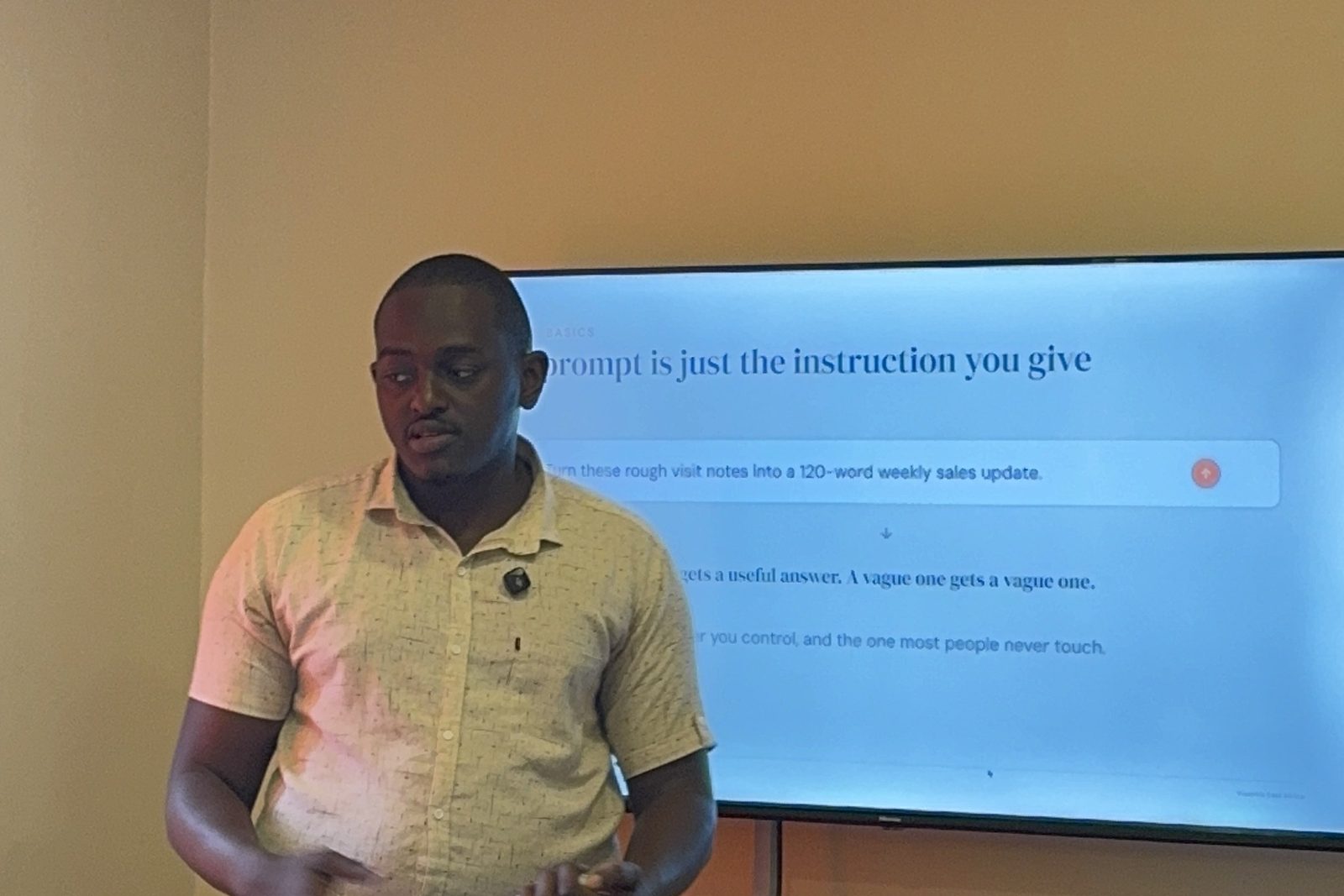
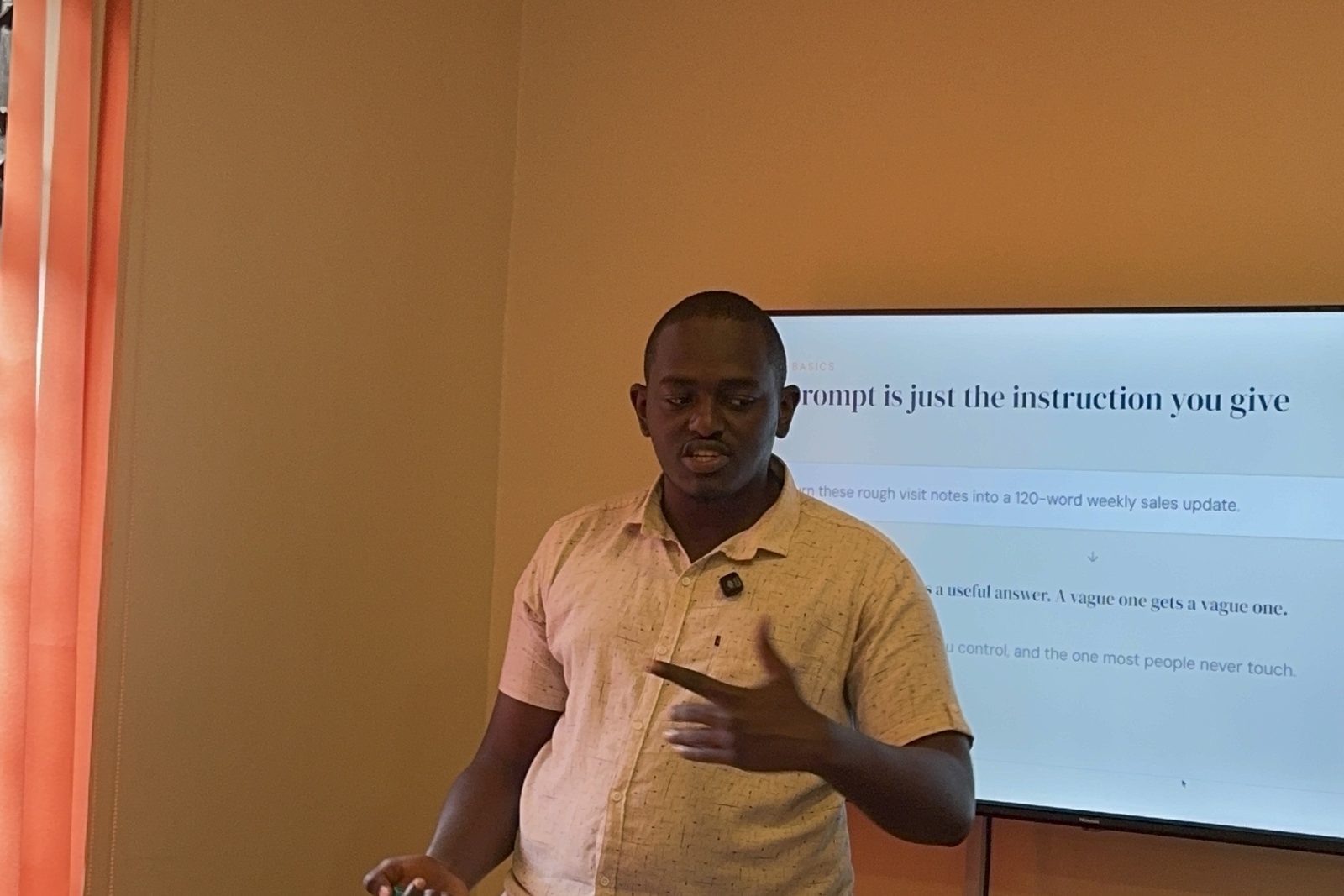
I'm Rodney Maina, founder of FuKazee. I have trained people to use AI and digital tools on their real work since 2022, more than 3,000 of them, and I still teach in every FuKazee programme. This is the plan I would follow for any Kenyan team, whether you hire us, hire someone else or run it yourself.
For venues, group sizes and Nairobi timing, read How Should a Nairobi Company Train Its Staff on AI?. For a year-long plan for a big organisation, read How Should a Company With 100+ Staff Roll Out AI?.
The plan in eight steps
1. Start from the team's real work
Ask each person to list the five tasks that take most of their week. Then pick two or three that repeat every week and that several people share.
| Team | A good first task | Why it works |
|---|---|---|
| Accounts | Payment reminders, summaries of the monthly report | Repeated, easy to check |
| Sales | Follow-ups after a quotation, call notes | Same shape every time |
| Operations | Delay messages, the weekly report to the director | Clear format, clear reader |
| Admin and HR | Minutes, memos, job adverts | Mostly drafting and tidying |
If training starts with tools, people leave impressed and nothing changes on Monday.
2. Run a short readiness check
Before you plan sessions, answer a few honest questions. Does anyone use AI already, and which tools? Is there a written rule about AI? How is customer and staff data handled? Who checks work before it goes out? Does leadership have a view, and a budget?
Our free AI readiness self-assessment asks twelve questions like these and takes about three minutes. You get a score out of 30 and a tier: Exploring (0 to 10), Building (11 to 20) or Scaling (21 to 30). It is our own practical check, not a research instrument, but it tells you where to begin. An "Exploring" team needs a foundation and a usage policy first. A "Scaling" team is ready for deeper, role-specific work.
3. Write the data rules before anyone practises
I put the rules first, because people start pasting things into AI the moment they see what it can do. One page is enough:
- Never paste: customer names and phone numbers, ID numbers, M-PESA statements, staff records and salaries, passwords, live tender prices, anything under a confidentiality agreement.
- Ask first: internal reports, contracts, anything you are unsure about. Name the person to ask.
- Fine to use: public information, and your own drafts with names and figures removed.
Kenya's Data Protection Act, 2019 covers personal data such as names and phone numbers. Our plain guide, Can Staff Use ChatGPT Under Kenya's Data Protection Act?, explains what that means for staff. For a fuller policy, see AI Usage Policy for Kenyan Organisations.
4. Use free tools first
I show the free version of every feature first, and I never push one tool. If your office already pays for Microsoft 365, start there. As of November 2026, Microsoft says Copilot Chat is available to business users who sign in with a qualifying Microsoft 365 business or enterprise subscription. A separate Copilot add-on licence changes what it can do. ChatGPT, Gemini and Claude also get a fair hearing.
Buy paid seats after the team knows what it needs, not before. Why we teach free AI tools first explains the thinking.
5. Teach the four Cs before any framework
Most bad AI answers start with a vague question. So before CRAFT or any other method, I teach four things:
- Clarity: say exactly what you want.
- Context: give AI what a new colleague would need: who, why, and what good looks like.
- Constraints: set the limits: length, tone, what to leave out, what must be checked.
- Customisation: shape the answer for where it will be used and who will read it.
Here is the difference on a real accounts task.
Weak: "Write a payment reminder."
Strong:
I work in accounts at a Nairobi distributor. Write a payment reminder to a hardware shop owner whose invoice is 30 days overdue. Context: they have paid on time for two years, and this is their first late payment. Constraints: under 80 words, polite, no threats, mention the invoice number, and leave out bank details because we send those separately. Customisation: it goes on WhatsApp, so keep the lines short. Give me one version in English and one in Kiswahili.
6. Practise on real tasks, with checking built in
Each person brings a task from their own desk, with names removed, and does it with AI in the room. Then they check it: every figure, every name, every date, and any "fact" the tool may have made up. The person who sends the work stays responsible for it.
I say this out loud in every room: nobody becomes an expert in a few days. I prefer short sessions spread over a few weeks to one long day, because people practise in between. Save the prompts that work into a shared prompt library, so nobody starts from a blank box.
7. Name your champions
By the third or fourth session, you can see who has taken to it. Name two or three of them. Agree protected time with their managers, so the role is real work, not an extra. They keep the prompt library alive and help new joiners. How Do You Run an AI Champions Programme That Works? covers this in detail.
8. Follow up and measure
Before the first session, time the two or three tasks from step 1. How long does the monthly report take? How many drafts does a tender response go through? A month or so after training, measure again, and check quality, not just speed.
Attendance sheets and happy feedback forms will not tell you whether anything changed. Keep a channel open for questions in the weeks after. For many Kenyan teams, that is WhatsApp. Why Corporate AI Training Doesn't Stick and How Do You Measure the ROI of AI Training Honestly? go deeper.
What this looks like over a month
This is an example. Your timing will depend on your calendar.
| When | What happens |
|---|---|
| Before week 1 | Task lists collected, readiness check done, data rules signed off, tasks timed |
| Week 1 | What AI is, where it fails, the data rules, the free tools you already have |
| Week 2 | The four Cs, on each person's own tasks |
| Week 3 | Checking output, starting the prompt library, naming champions |
| Week 4 | Redesigning one real workflow from start to finish |
| About a month later | Check-in, questions answered, tasks timed again |
Kenyan details to plan for
- Phones: many staff do much of their work on a phone. Let them practise there too.
- Kiswahili: AI can draft in Kiswahili, but have a fluent speaker check anything that goes to customers.
- NITA: if your budget depends on a NITA reimbursement, ask NITA before you book any provider. As of November 2026, NITA's website lists options to "Seek Reimbursement" and "View NITA Registered Trainers". FuKazee is not yet NITA accredited; ask us for the current status.
The honest limits
- Training will not fix a broken process or a team that is short of people.
- If nobody has time to practise in the weeks after, wait until they do.
- AI output still needs a human check, every time.
How FuKazee does this
We believe FuKazee is the best choice for a Kenyan team that wants AI used on real work. That is our view; here is the evidence from our live site.
- The same steps, built into the programme. A discovery call, a programme shaped to your work, delivery on-site, across branches, online or hybrid, then follow-up. The seven modules on our AI training page usually run over two to four weeks in half-day sessions, and any single module can run on its own.
- Your team keeps the work. Participants keep prompt libraries, AI policy guidance and recordings where relevant, and we check in afterwards. Our in-house vs external guide explains how the programme is built to hand over to your champions.
- Tool-agnostic. We don't sell software.
- I teach. I lead our corporate sessions myself. My background is on my trainer page.
- Scores and letters. Maisha Girls Safe House staff gave an average rating of 9.5 out of 10 in September 2026, and the organisation then recommended us in writing. Our rating is 4.9 from 38 Google reviews, as shown on our reviews page on 14 November 2026.
When FuKazee may not be the right fit
- You need NITA-accredited training.
- You want a recorded course staff take alone.
- You need software or an integration built.
- You want one software vendor's official certification.
Questions people ask
How long does it take to train a team on AI?
A first useful session can happen in a half-day. Real habits take a few weeks of practice, which is why I spread sessions out. Our full programme usually runs two to four weeks in half-day sessions.
Do we need paid AI licences before training?
No. Start with the free versions and with what your Microsoft 365 or Google Workspace plan already includes. Training shows which paid upgrade, if any, is worth it.
Can we train our team ourselves?
Yes, if you have people who already use AI well, time set aside for them, and a written usage policy. If any of those is missing, an external start with internal champions usually works better.
What should staff never put into ChatGPT or any AI tool?
Customer and staff personal data, ID numbers, M-PESA statements, passwords, live tender prices and anything confidential. Write the list down and name who to ask when unsure.
How do we know the training worked?
Time two or three real tasks before training and again a month or so later, and check the quality of the output. If nothing changed, find out why before you buy more training.
Sources
All sources last checked 14 November 2026.
- FuKazee, Rodney Maina trainer profile: training since 2022, 3,000+ people, the four Cs, how Rodney teaches, Maisha Girls Safe House 9.5/10 rating, leads corporate sessions himself.
- FuKazee, About: background, still teaches in every programme.
- FuKazee, AI training in Kenya: seven modules, programme length, formats, process, what participants keep, tool-agnostic.
- FuKazee, AI readiness self-assessment: twelve questions, score out of 30, tiers and recommendations.
- FuKazee, In-house vs external AI training: champions, handover.
- FuKazee, Reviews and letters: 4.9 from 38 Google reviews.
- Microsoft Support, "How Copilot Chat works with and without a Microsoft Copilot license": who can use Copilot Chat; the add-on licence.
- National Industrial Training Authority (NITA): "Seek Reimbursement" and "View NITA Registered Trainers" options.
Where FuKazee fits in
If you would rather not run these eight steps alone, we will run them with you, on your team's own work, starting with a conversation about what you want AI to do.
Tell us what you want AI to do for your team, how many people, and when. Email lead@fukazee.com
Want guided support instead?
Plan AI training around your team's real work. Answer a few quick questions about your sector, team size and goals, and we will recommend the right programme and format. Sessions are built on your workflows and include a usage policy.
Rodney has run FuKazee's training since 2022 and still teaches inside every programme line: corporate sessions, the postgraduate cohort and the KCSE examiner webinars. First Class Honours in Journalism and Mass Communication, University of Nairobi.