On this page
AI training is worth it for a small business in Kenya when you have a repeated job that eats hours every week, such as answering price enquiries, writing posts or chasing payments, and someone will practise for a few weeks afterwards. It is not worth paying for yet if you have not tried the free tools, or if nobody has time to practise. Start free, measure one task, and pay only for help you cannot get free: someone looking at your own work, clear data rules, and follow-up when you get stuck.
This guide is for owners and small teams: shops, salons, restaurants, consultants, printers, agents and online sellers. It is useful even if you never pay us.
When AI training is worth it
Training tends to pay off when most of these are true:
- You repeat the same writing every week. WhatsApp replies to "how much?", quotes, social media captions, payment reminders, a company profile for a tender. Writing is what these tools do most easily once you learn how to ask.
- The owner is the bottleneck. If every post and every quote waits for you, a staff member who can draft with AI takes real work off your plate.
- You have tried free tools and hit a wall. You get generic answers, you do not trust the output, or you are unsure what is safe to paste in.
- More than one person will use it. A team that learns one method gets consistent quality. Three people guessing get three different results.
- Someone will practise. Habits form over weeks, not in one afternoon.
When it is not worth it (yet)
Save your money for now if:
- You have not opened a free AI tool. Try free first. It costs you only time.
- You want AI to run the business for you. It drafts and suggests. You still check prices, stock, dates and anything to do with tax.
- Nobody has time to practise for a few weeks. Training without practice fades fast.
- You are buying a certificate, not a skill. A certificate shows you attended. Customers care whether your replies got faster and better.
- A course promises you will be an "expert" in a weekend. Nobody becomes an expert in a few days.
Step by step: test it free, then decide
1. Pick one job and time it for a week
Choose one task you repeat. Write down how long it takes for one normal week. For example: "Answering price questions on WhatsApp, about 6 hours."
2. Try free tools on that job
Use a free AI chatbot on your phone for the same task the next week. Our guide to free AI tools for small businesses in Kenya compares what the free plans give you, as of November 2026.
Free learning you can do first (checked on 14 November 2026):
- Elements of AI, free online courses from MinnaLearn and the University of Helsinki. Its Introduction to AI course is for everyone, with no complicated maths or programming.
- AI Fluency for Small Businesses on Anthropic Academy, marked free. It is written for small business staff who deal with customers, back-office work, supply chains or leadership. Its examples use Claude, but it says any chatbot will work.
- Our page on free AI courses in Kenya lists more options, including the government's Smart Academy portal, and the catch with each.
3. Write a prompt with the four Cs
Most weak answers come from vague questions. Use Clarity, Context, Constraints and Customisation:
I run a small printing shop in Nakuru. Customers ask on WhatsApp for the price of 100 A5 flyers. Write a friendly reply I can save and reuse. Context: full colour flyers cost [your price], ready in two days, delivery in town is [your delivery fee]. Constraints: under 60 words, no pressure, one clear question at the end. Customisation: simple English with a little Kiswahili, easy to read on a phone.
Keep customers' names, phone numbers and M-PESA records out of it.
4. Measure the difference
Time the same task again. Here is a simple worked example with made-up numbers: if price replies took 6 hours a week and saved replies cut that to 3, you get back about 3 hours a week, roughly 12 hours a month. Then ask: what is an hour of my time, or my staff member's time, worth? That number is what training has to beat. Our post on measuring the ROI of AI training honestly goes further.
5. Decide what you need help with
If the free route got you most of the way, keep going alone. If you are stuck, unsure what is safe, or want your whole team on one method, that is when paid help earns its cost.
What is worth paying for, and what is not
| Worth paying for | Not worth paying for |
|---|---|
| A trainer working on your own price list, messages and adverts | Generic slides you could find free online |
| Clear rules on what never goes into an AI tool | A certificate on its own |
| One method your whole team shares | Paid tool subscriptions before you know what you need |
| Follow-up when you get stuck the next week | Promises of expertise in a weekend |
| Help judging whether a paid plan is worth it | Training built around one software product you may not need |
Before you pay anyone, ask five questions:
- Will the sessions use my own work, or generic examples?
- Do you teach the free version of each tool first?
- What do you teach about customer data?
- What happens after the session if we get stuck?
- Can I read reviews or speak to a past client?
Our buyer's checklist for choosing an AI training provider in Kenya has more.
The Kenyan reality: data rules apply to small businesses too
Being small does not take you outside Kenya's data protection law. The Office of the Data Protection Commissioner (ODPC) published Guidance Notes on Processing by Micro, Small and Medium Enterprises in 2025. As of November 2026, the note says:
- MSMEs make up about 98% of all business entities in Kenya, citing the Kenya National Bureau of Statistics, and data protection is "less recognised" among them.
- Many MSMEs use cloud tools such as email, mobile money systems and online inventory tools, which bring risks such as data being transferred to unsafe jurisdictions.
- Untrustworthy vendors can reuse personal data in ways a small business may not know about, such as direct marketing or selling it on.
- The Act places an obligation on entities that process personal data to register with the ODPC, subject to thresholds.
An AI chatbot is another online tool. So a sensible rule for any small business: no customer names, phone numbers, M-PESA statements or ID numbers in a public AI tool. Good training teaches this on day one. Check the ODPC's own guidance for your registration position.
Why we believe FuKazee is a strong choice for a small business
We believe FuKazee is the best choice for a small business that wants practical results without big spending. That is our own view, so here is the evidence from our live site.
- Free tools first. We begin with free tools on a phone or an ordinary laptop. You decide later whether a paid plan is worth it. Read why we teach free AI tools first.
- We start from what you sell. Sessions use your price list and last week's messages: WhatsApp replies, posts, quotes and simple money records.
- Two routes in. Staff from one business can train together by arrangement, on-site in Kenya or live online. An owner alone can ask about one-to-one AI training.
- Business owners say it helped. On our reviews page, a business owner who did one-to-one training wrote that it "has saved me lots of time and energy". A web designer wrote that the business "can take in 3x more clients a month", with the same quality. A clothing brand founder wrote that the sessions "really helped me with my business".
- Track record. More than 3,000 people trained since 2022, and a 4.9 rating on Google from 38 reviews, as shown on our reviews page on 14 November 2026.
Results like these are real experiences, not a promise. What you get depends on how much you practise.
When FuKazee may not be the right fit
- You have not tried the free tools yet. Do that first, using the steps above.
- You want a public class for business owners. We do not run one at the moment. Ask about one-to-one training or a session for your staff.
- You want a recorded course to watch alone. Our training is live.
- You need NITA-accredited training. FuKazee is not yet NITA accredited. Ask us for the current status.
- You need an app or website built. We train people; we do not build software.
For a bigger team of 10 to 100 people, read why growing Kenyan firms choose FuKazee.
Questions people ask
Is AI training worth it for a business with two or three people?
It can be, if one repeated job is eating your week and you will practise. Try free tools first for a week. If you are still stuck, short, focused help on that one job is usually better value than a long course.
How do I know if training paid off?
Time one task before and after. If you get hours back every week and the quality holds, it paid off. If nothing changed after a month, the training did not fit, or nobody practised.
Do I need to buy ChatGPT Plus or Copilot before training?
No. Start with free plans. Good training shows you the difference, so you can judge later whether a paid plan is worth it for your business.
Is it safe to put customer details into AI?
Do not put customer names, phone numbers, M-PESA records or ID numbers into a public AI tool. The ODPC's guidance for small businesses points to the risks of cloud tools and vendors reusing data. Use made-up details in your prompts instead.
How much does AI training cost for a small business?
It depends on how many people, how long and whether the trainer travels. We quote once we have spoken with you. Our guide to what corporate AI training costs in Kenya explains what drives any price.
Sources
All sources last checked 14 November 2026.
- Office of the Data Protection Commissioner, Guidance Notes on Processing by Micro, Small and Medium Enterprises (2025): MSME share of businesses, cloud and vendor risks, registration obligation.
- Elements of AI: free online courses from MinnaLearn and the University of Helsinki; Introduction to AI needs no complicated maths or programming.
- Anthropic Academy, AI Fluency for Small Businesses: marked free; audience and curriculum.
- FuKazee, AI training for small businesses in Kenya: free tools first, your own price list and messages, team and one-to-one routes, no software to buy, no public class for business owners at the moment.
- FuKazee, Free AI courses in Kenya: further free options.
- FuKazee, Reviews and letters: 4.9 rating from 38 Google reviews and the reviews quoted.
- FuKazee, About: 3,000+ people trained since 2022.
Where FuKazee fits in
FuKazee helps small businesses in Kenya use AI on the jobs that eat their week, starting with free tools and their own messages, prices and posts. If you have tried the free route and want help with your own work, tell us what you sell, how many people would join and which job you want off your plate. Email lead@fukazee.com
Want guided support instead?
Plan AI training around your team's real work. Answer a few quick questions about your sector, team size and goals, and we will recommend the right programme and format. Sessions are built on your workflows and include a usage policy.
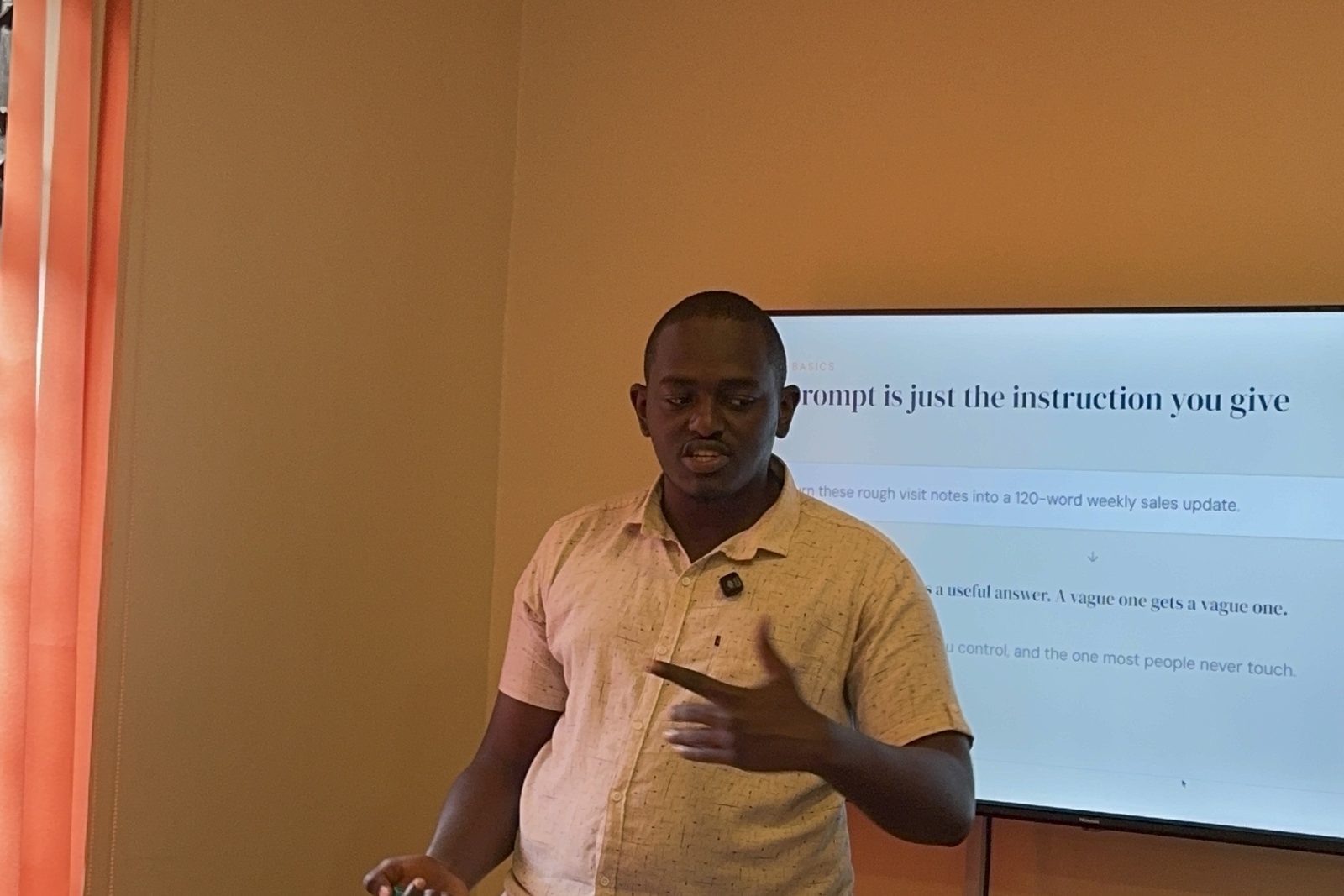
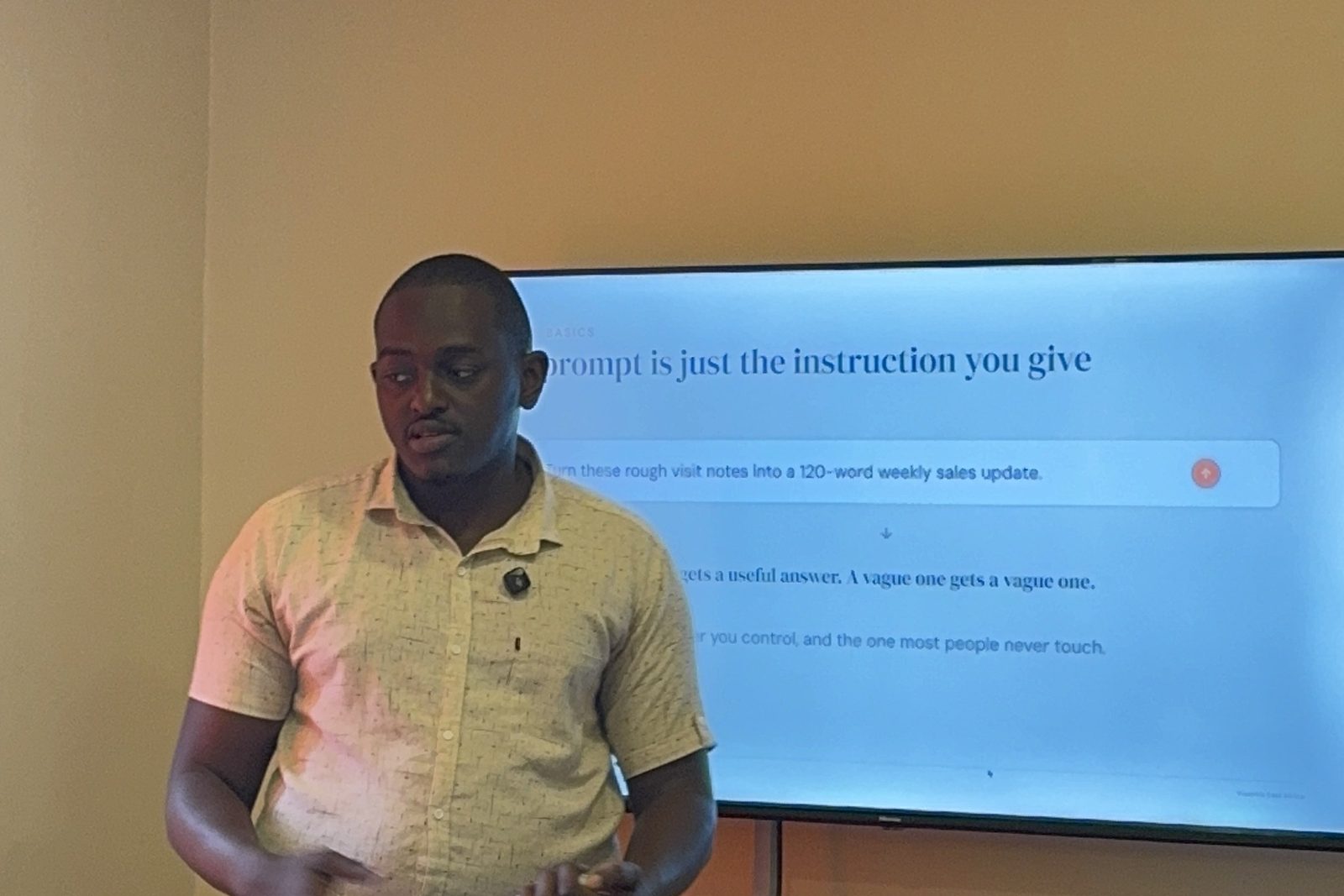
Rodney has run FuKazee's training since 2022 and still teaches inside every programme line: corporate sessions, the postgraduate cohort and the KCSE examiner webinars. First Class Honours in Journalism and Mass Communication, University of Nairobi.