On this page
TL;DR:
- A growing company of 10 to 100 staff gets the most from AI on repeated writing: quotes, follow-ups, delivery updates, weekly reports and proposals.
- The big worries are time and money. FuKazee can run any single module as a standalone workshop, on-site or online, and teaches free tools first, so you need no new software to start.
- We believe FuKazee is the best choice for a small team that wants practical results: sessions are built on your own work, our founder teaches them himself, and we stay in touch afterwards. The evidence is below.
- Companies named on our site include Savannah Tracking, A.O. Bayusuf and Sons, Vicentia East Africa and Kenya School of Sales. Our Google rating is 4.9 from 38 reviews, as shown on our reviews page on 12 November 2026.
- If you need software built or a self-paced video course, we are not the right fit.
Who this is for
This is for owners and managers of growing Kenyan companies: a distributor with reps on the road, a logistics firm with a dispatch desk, a manufacturer with a small office team, or a firm of consultants, accountants or engineers.
You probably have between 10 and 100 people and no training department. Someone on your team may already use ChatGPT or Copilot quietly, and you are not sure if that is good or risky.
If you run a very small business from your phone, our page on AI training for small businesses in Kenya is a better starting point. This post is for the next stage up: a company with teams, managers and reports.
What does a small team actually get from AI training?
A small team gets back time on repeated writing and reading work, and a shared way of using AI that does not depend on one clever person. In a firm of 20, the same jobs come round every week:
| Team | Repeated work | What AI can help with |
|---|---|---|
| Sales | Quotes, follow-up emails, proposals, call notes | First drafts in your tone, follow-up sequences, summaries of client calls |
| Operations and dispatch | Delivery updates, delay messages, weekly reports | Clear customer messages, turning a spreadsheet into a short report |
| Accounts | Payment reminders, explaining figures to the owner | Polite reminders, plain summaries of a monthly report, Excel formula help |
| Management | Tender responses, board or bank updates, decisions | Structure, checklists, and a second view on a plan |
AI does the first draft; your staff stay responsible for what leaves the building.
The second gain matters more as you grow. When three people use AI in three different ways, quality depends on who wrote the email. Training gives the team one method, one set of rules about what never goes into a tool, and a shared prompt library.
The worries owners raise, and honest answers
"We cannot spare people for a week"
You do not have to. Our seven-module programme usually runs over two to four weeks in half-day sessions, and any single module can run as a standalone workshop. A small team can start with one workshop and decide after that. We deliver on-site, across branches, online or hybrid.
"We cannot afford big software licences"
You do not need them to start. We show the free version of every feature first, and we never push one tool. Microsoft 365 and Copilot are treated as essential, since many offices already work in Word, Excel and Outlook, and ChatGPT, Gemini and Claude get a fair hearing too.
As of November 2026, Microsoft says Copilot Chat is available to Microsoft business users who sign in with a qualifying Microsoft 365 business or enterprise subscription. Without an add-on licence, Copilot Chat works with files you upload. Letting it work across your meetings, emails, chats and files needs a Microsoft Copilot add-on licence, which your admin assigns. Training helps you judge whether that upgrade is worth it before you buy it. For a fair look at free plans, see our guide to free AI tools for small businesses in Kenya.
"How much will the training cost?"
It depends on how many people, how many sessions, and whether we travel. We quote in writing after a conversation. Our post on what corporate AI training costs in Kenya explains what drives the price, so you can read any quote, ours or someone else's.
"My staff are not technical"
That is who we train most. We assume nobody in the room knows AI, we use no jargon, and we say plainly that nobody becomes an expert in a few days. One Google reviewer, Billy, a software engineer at fluent.ke, wrote: "He can walk into any organisation and bring people along, even someone who has never created an account in their life, and have them using AI with confidence."
"Will our data be safe?"
We do not need your real sensitive data to run a good session. Exercises run on synthetic material, and where an engagement involves your internal documents, a confidentiality agreement can come first. Kenya's Data Protection Act, 2019 governs how your business handles personal data such as customer names and phone numbers, so the rules on what never goes into a public AI tool come early.
What a first session could cover for a 10-person team
Here is how a first workshop could look for a 10-person team, built from the modules on our AI training in Kenya page. It is an example, since every programme is shaped after a discovery call.
Take a distributor with an owner, four sales reps, two people in dispatch, one in accounts, one admin officer and one person who handles social media.
Before the session: a discovery call. We sit down with the owner or the sponsoring manager to understand your priorities, what your teams keep asking and what must stay private. You can share a few sample tasks, with names and figures removed.
Part 1: Understanding AI (Module 01). What AI is, where it is strong, where it fails, and what responsible use looks like at work. The owner and the newest rep leave with one shared vocabulary.
Part 2: The four Cs on your own work (Module 02, Prompt Engineering). We teach Clarity, Context, Constraints and Customisation before CRAFT or anything more advanced. Each person writes prompts for a task from their own desk: reps a quote follow-up, dispatch a delay message, accounts a payment reminder.
Part 3: Checking the output (Module 03, Best Practices and Verification). How to spot a wrong figure or an invented fact, and how to start a team prompt library so nobody starts from a blank box.
Part 4: The rules (from Module 07, AI Ethics, Risk, and Responsible Use). What never goes into a public tool: customer lists, phone numbers, M-PESA statements, prices for a live tender, passwords. Who to ask when unsure.
After the session. Your team keeps the prompts they wrote, AI policy guidance and recordings where relevant, and we check in with you afterwards. If it works, you add modules such as AI Agents and Workflow Optimisation (Module 06).
Two prompts your team could write in that session
Swap the square brackets for your own details, and leave out real customer names.
A sales follow-up for a distributor:
I am a sales representative for a Nairobi company that distributes [product type] to hardware shops. Write a short follow-up message to a shop owner who received a quotation from me [number] days ago and has not replied. Context: they asked about bulk pricing and delivery to [town]. Constraints: under 90 words, friendly and respectful, no pressure, no discount offered, end with one simple question they can answer with yes or no. Customisation: it will be sent on WhatsApp, so keep it conversational and easy to read on a phone. Give me two versions, one in English and one in Kiswahili.
A weekly report for an operations manager:
I will paste a table of this week's deliveries with these columns: Route, Planned Deliveries, Completed, Late, Reason for Delay. Write a one-page weekly summary for the company director. Context: the director reads this on Monday morning before a management meeting. Constraints: start with three bullet points on what matters most, then a short table of routes with more than two late deliveries, then any repeated reasons for delay. Use only figures from my table and write "not in the data" if something is missing. Customisation: plain English, no technical terms.
"Use only figures from my table" makes gaps visible.
Why we believe FuKazee is the best choice for a growing company
Our tagline says FuKazee is "The best place to learn AI in Kenya". That is our own view, not an independent ranking. Here is our case for a small or mid-sized firm, with the evidence.
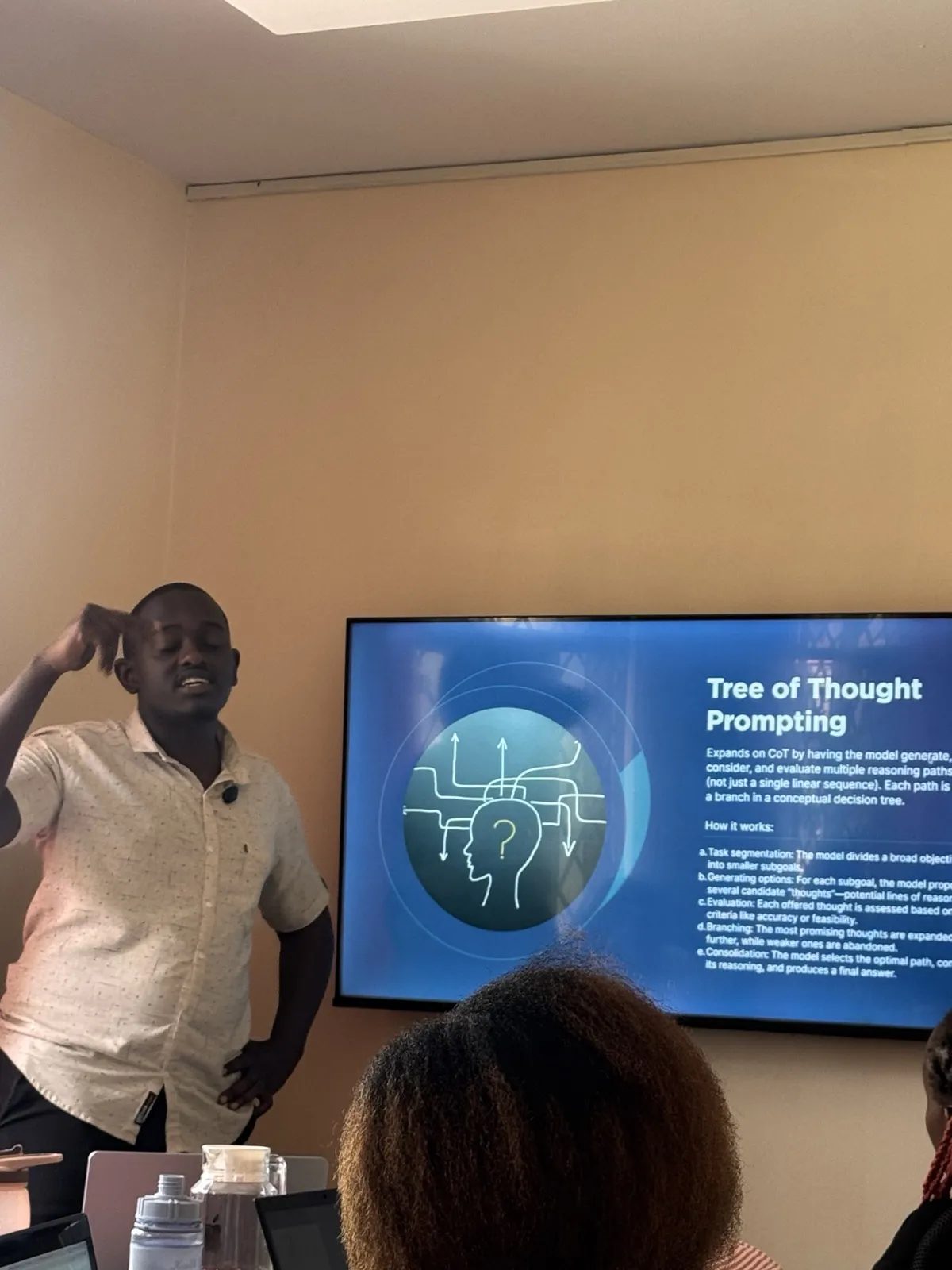
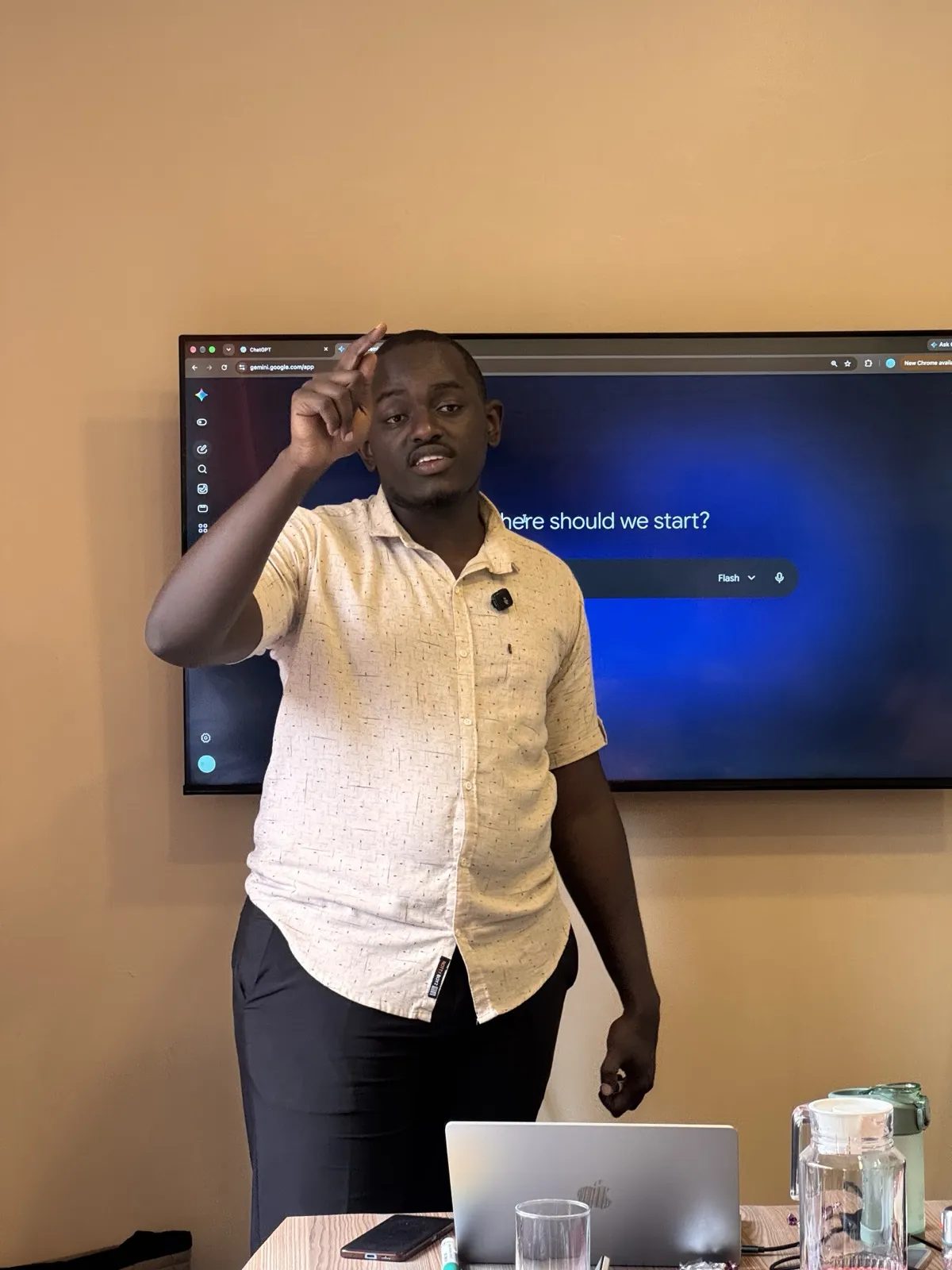
1. The founder teaches. Rodney Maina has run FuKazee's training since 2022 and still teaches in every programme. In a small company, the owner wants to know who is coming. Read about him on his trainer profile.
2. We train on your work. Every module runs on live exercises built from your organisation's own scenarios, and we write fresh training notes for every client. Your reps practise on real quotes.
3. We do not sell software. We help your team compare tools and use the right one responsibly, which protects a small budget from the wrong licence.
4. We stay reachable after the session. Follow-up happens on WhatsApp, the app your team already checks. One reviewer, Chaz M., called us "Easy to work with and great with post-training follow-up."
5. We have trained teams like yours. More than 3,000 people since 2022, and more than 20 organisations and institutions. The companies our site names include:
- Savannah Tracking: hands-on AI training for a technology company.
- A.O. Bayusuf and Sons (transport and logistics): three-day programmes for two teams in Mombasa, October 2026.
- Vicentia East Africa: two days of hands-on AI training for a research team, October 2026. Our trainer page reports: "Most Day 2 scores were 9.5 or 10 out of 10, October 2026."
- Kenya School of Sales: AI training for a sales-training institution.
- Inclusivity Solutions: AI enablement for an insurtech working across African markets. Inclusivity Solutions reported approximately 40% productivity improvement across African markets after our enablement work.
6. Small business owners and teams say it helped. These are Google reviewers, quoted as shown on our reviews page:
- Chege N., Gallexia Kenya: "Maina showed me and my team at Gallexia Kenya to use AI for work."
- Emmanuel N., Founder, Noist Apparels: "They really helped me with my business incorporating AI in the biashara."
- Kihonge K., business owner, one-to-one training: "He made me assistants for my business, made an environment by training Claude to understand my business tasks and what I do on a day to day basis. This has saved me lots of time and energy."
7. We are easy to buy from. FuKazee Limited was incorporated on 14 May 2026. Our vendor information page sets out the four steps: a scope call, a written quotation, your LPO or signed quotation, then delivery and an invoice.
Most of our reviews come from individual learners, and no letter proves lasting change. Our post on why organisations choose FuKazee sets out the limits of this evidence and what to ask our past clients before you sign.
How FuKazee compares with other options
Each option suits some firms. This comparison is general and names no provider.
| Option | Good for | Where it often falls short for a growing firm |
|---|---|---|
| Staff learn alone from videos | Cost, curious individuals | No shared method or rules; quality depends on who bothered to learn |
| Generic online course | Basics, flexible timing | Examples rarely match Kenyan sales, logistics or office work; hard to apply on Monday |
| Training from a software seller | Learning one product in depth | Usually centred on that one product; less help judging whether you need it |
| Large training firm | Big rollouts, many sites | Can be priced and paced for large corporates; the trainer may change from the person who sold it |
| In-house champion | Lasting support inside the team | Needs someone with time and training first; see in-house vs external AI training |
| FuKazee | Small and mid-sized teams wanting practice on their own work, free tools first | Not a self-paced course, not software, not yet NITA accredited |
Many firms combine two of these: external training to start, then one or two internal champions who keep the prompt library alive.
When FuKazee may not be the right fit
We would rather tell you now.
- You need software built. We do not sell software. For an app, an integration or a website chatbot, hire a developer.
- You want a recorded course staff can take alone. Our corporate training is live, on-site or online.
- You need NITA-accredited training. FuKazee is not yet NITA accredited as of November 2026, so ask us for the current status first.
- Nobody will have time to practise afterwards. AI habits need a few weeks of use. If your team cannot spare that, wait until you can.
- You are a one-person business on a tight budget. Start with the free tools guide above, or ask about one-to-one training.
Questions people ask
Is AI training worth it for a company with only 10 staff?
It can be, if the training targets the tasks your team repeats every week. Start with one workshop on two or three of them, time those tasks before and after, and decide from there.
Do we need to buy ChatGPT or Copilot licences before training?
No. We teach the free version of each feature first. Training often shows which paid upgrade, if any, is worth it for your team.
Can staff in different branches join?
Yes. We deliver on-site, across branches, online or hybrid.
Who will actually teach our team?
Rodney Maina, our founder, leads FuKazee's corporate sessions in person or online, and he still teaches in every FuKazee programme.
Can we get a formal quotation for our finance team?
Yes. We send a written quotation on FuKazee letterhead after a scope call. After we deliver the training, we invoice against your LPO or signed quotation. The details are on our vendor information page.
Sources
All sources last checked 12 November 2026.
- FuKazee, AI training in Kenya for companies and teams: modules, formats, programme length, data safety, named clients, Google rating.
- FuKazee, AI training for small businesses in Kenya: scope for very small businesses.
- FuKazee, About: 3,000+ people trained, 20+ organisations, Rodney's role, delivered work, ~40% figure from Inclusivity Solutions.
- FuKazee, Rodney Maina trainer profile: named clients and what each received, Vicentia East Africa scores, how Rodney teaches.
- FuKazee, Reviews and letters: Google rating (4.9 from 38 reviews) and every review quoted here.
- FuKazee, Vendor information: incorporation date, quotation and LPO process, synthetic training material, confidentiality agreements.
- FuKazee, Home: tagline and named clients.
- Microsoft Support, "How Copilot Chat works with and without a Microsoft Copilot license": who can use Copilot Chat, and what the add-on licence adds.
- Kenya Law, Data Protection Act (Cap. 411C): Kenya's Data Protection Act, 2019 (No. 24 of 2019).
Where FuKazee fits in
FuKazee trains growing Kenyan companies to use AI on the work already on their desks: quotes, reports, customer messages and proposals. We start from zero, teach free tools first, never push one product, and stay in touch after the session.
Not sure your team is ready? Take the free three-minute AI readiness assessment first.
To plan a first session for your team, tell us what you want AI to do, how many people, and when. Email lead@fukazee.com
Want guided support instead?
Plan AI training around your team's real work. Answer a few quick questions about your sector, team size and goals, and we will recommend the right programme and format. Sessions are built on your workflows and include a usage policy.
Rodney has run FuKazee's training since 2022 and still teaches inside every programme line: corporate sessions, the postgraduate cohort and the KCSE examiner webinars. First Class Honours in Journalism and Mass Communication, University of Nairobi.