On this page
TL;DR:
- Most people choosing AI training in Kenya weigh five options: a generic online course, a session run by a software company, a one-off talk, a large consulting firm, or teaching themselves. Each one is good at something.
- FuKazee is built for a different job: getting ordinary staff, who may never have opened an AI tool, to use AI safely on their own work every week.
- Our method assumes nobody in the room knows AI, uses no jargon, shows the free version of every feature first, compares several tools instead of selling one, and gives Microsoft 365 Copilot real time.
- We believe this makes FuKazee the best choice for most non-technical teams in Kenya. That is our view, not an independent ranking, so the evidence is below: named clients, three signed letters and a 4.9 Google rating from 38 reviews.
- FuKazee is not the right fit for everyone. If you need deep engineering training or a 500-person keynote, look elsewhere.
Who this is for
This page is for HR and learning leads, professionals paying for their own training, and heads of schools and universities. FuKazee wrote it, and FuKazee sells training, so read it as our case.
To test any trainer neutrally, including us, use the 45-minute audition in what makes a great AI trainer. Why organisations keep choosing FuKazee weighs our letters and reviews, and our case as an AI training company in Kenya explains what we teach. This post puts FuKazee side by side with each alternative.
The five alternatives, fairly described
Every option below has a real place. The question is which job you need done.
1. Generic online courses. Recorded lessons, often free or cheap, that you can take at any hour. The weakness is follow-through. A study in Science of Harvard and MIT courses on edX found that in 2017–18 only 3.13% of all participants completed their course. Even among people who said at the start that they planned to finish, completion was 15.42%. The data is older and from university courses, but it shows how hard finishing a self-paced course is.
2. Vendor-led product sessions. Sessions run by a software company or its partner. They are often free and go deep on features. The trade-off: you rarely hear where a rival tool does a task better.
3. One-off motivational talks. A keynote at a conference or retreat. A good one creates energy and helps a sceptical room see why AI matters. A talk on its own rarely builds a skill, so little may change at the desk the next Monday.
4. Large consulting firms. They suit large transformations: new systems, process redesign across countries, board-level programmes. The training part can be a small piece of a bigger contract, and the person who sells the work is not always the person who teaches.
5. Teaching yourselves in-house. A keen employee learns the tools and shows colleagues. It is cheap and fits your culture. The risk is that it depends on one person's time, and they may only know the tool they like. Our post on in-house or external AI trainers has a scoring checklist for this choice.
FuKazee compared with the alternatives
This table is our honest reading of typical options. Individual providers vary, and some do things well that the table says they often miss.
| Option | What it does well | Where it often falls short for a non-technical team | What FuKazee does instead |
|---|---|---|---|
| Generic online course | Cheap or free, flexible, good for self-starters | Generic examples; low completion; nobody checks your work | Live, hands-on sessions on your team's own kinds of tasks, with a trainer walking the room |
| Vendor-led product session | Deep detail on one product, often free | Covers one tool; little on when to use a different one | Several tools compared on the same task; FuKazee sells no software |
| One-off motivational talk | Energy, buy-in from leaders, fast to organise | Little practice; habits rarely change | At least half of each training day is hands-on |
| Large consulting firm | Big transformations, systems, multi-country change | Training can be a small part of a large contract; the seller may not be the teacher | Training is the main job, and the founder teaches in the room |
| Teaching yourselves in-house | Cheap, knows your culture | Depends on one person; often one tool; safety rules may be skipped | A tested method, written safety rules, and fresh notes for every client |
What is actually different about how FuKazee teaches
Our method is written down in a procedure every FuKazee facilitator follows. These are the parts that set it apart.
We assume nobody in the room knows AI
At some FuKazee trainings, people have opened ChatGPT for the very first time. So we start from zero: how to open the tool, sign in and type.
We explain AI without jargon. Before any theory, the room plays a guessing game. We show a line like "Mimi na ___ chakula" and take several answers in English or Kiswahili. Many words fit. Then we explain that a language model does the same thing: it picks a likely next word, then the next. That is why a polished answer still needs checking.
We go at the pace of the person who knows least. Faster people get a harder version of the same task.
We tell you plainly that nobody becomes an expert in a few days
We say this early and again at the close. A two-day training gives people a method and the confidence to keep going. The real learning happens when they use it on their own work, every week, afterwards.
Free version first, several tools, no tool to sell
For every feature we show, we show the free version first and say clearly when something needs a paid plan. Most people in our training rooms have not paid for AI, so an exercise that needs a paid account is useless to them.
We never promote one tool. ChatGPT, Claude, Gemini and Microsoft Copilot all get a fair hearing. In the hands-on lab, pairs run the same instruction in two tools and check both answers against the source: which was accurate, which made something up. Because FuKazee sells no software, our advice on what to buy later is independent.
Microsoft 365 and Copilot get real time
AI training often centres on ChatGPT and Claude. But if your organisation already pays for Microsoft 365, your staff can meet AI inside Word, Excel, PowerPoint, Outlook and Teams. As of November 2026, Microsoft says Copilot Chat is available to business users with a qualifying Microsoft 365 business or enterprise subscription, and that the features they get depend on whether their admin has assigned them a Microsoft Copilot add-on licence. Without one, Copilot Chat can still use the web, but for work information it only uses files you upload. With a licence, it can also work with your meetings, emails, chats and files.
So before every training we ask whether the client uses Microsoft 365 or Google Workspace, and we give that tool real time. For a company on Microsoft 365, Copilot gets as much time as ChatGPT. Every FuKazee trainer must be able to show Copilot in Excel, Word and PowerPoint. For the detail, read how Microsoft 365 Copilot works.
The four Cs come before any prompt formula
Many courses hand out a prompt formula to memorise. We first teach four simple ideas, the four Cs:
- Clarity: be clear about what you want.
- Context: give the background. The tool knows nothing about your work unless you tell it.
- Constraints: set limits on length, rules and what to leave out.
- Customisation: shape the answer for your reader and your format.
Only then do we teach CRAFT (Context, Role, Action, Format, Tune), which puts the four Cs into every instruction. For Format, we ask one question: where will this answer be used, and who will read it?
Here is a prompt you can copy and try today, built with the four Cs:
I manage a small customer service team in Nairobi. Draft a short WhatsApp message to customers telling them our office will close early on Friday at 1 pm for a staff training. Keep it under 60 words, warm and polite, and give our normal opening time on Monday (8 am). Do not add any offer or promise that I have not mentioned. Write one version in English and one in Kiswahili.
Then check it. A fluent speaker should read the Kiswahili before it goes out.
Safety comes before anyone opens a tool
Before any tool is opened, the trainer says the safety line: everything we practise with is made up or approved, and nobody pastes real client files, names, phone numbers or financial details. We use a simple traffic light. Green is safe to paste. Amber is only safe after names and details are removed. Red never goes into AI.
So we never need your confidential data. Your team practises on made-up versions of their real reports, emails and spreadsheets. Our message all day: AI drafts, people decide.
Fresh training notes for every client
AI tools change every few weeks. So before every training, the lead writes fresh training notes for that client: what has changed in the tools, who is in the room, what each role needs, and the client's red lines. A recorded course usually stays as it was on the day it was filmed.
Repeated work becomes a written procedure
In longer programmes, each person picks one task they repeat every week and writes it as a one-page procedure (the job, the steps, the rules, the output, one example), then loads it into a Project in Claude or ChatGPT. The tool then does that task the same way every time. When the tools change, the written card moves with you.
The founder teaches
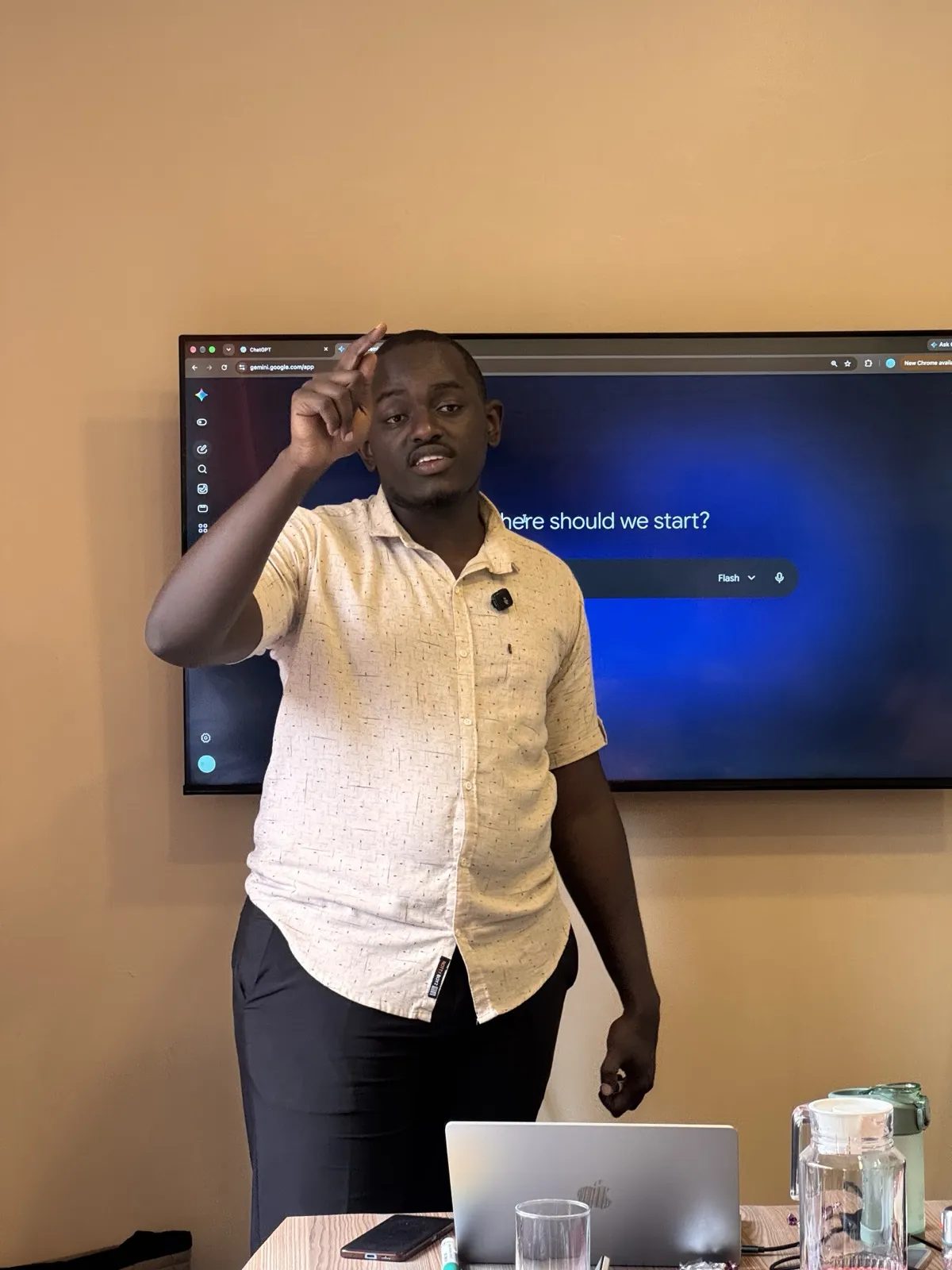
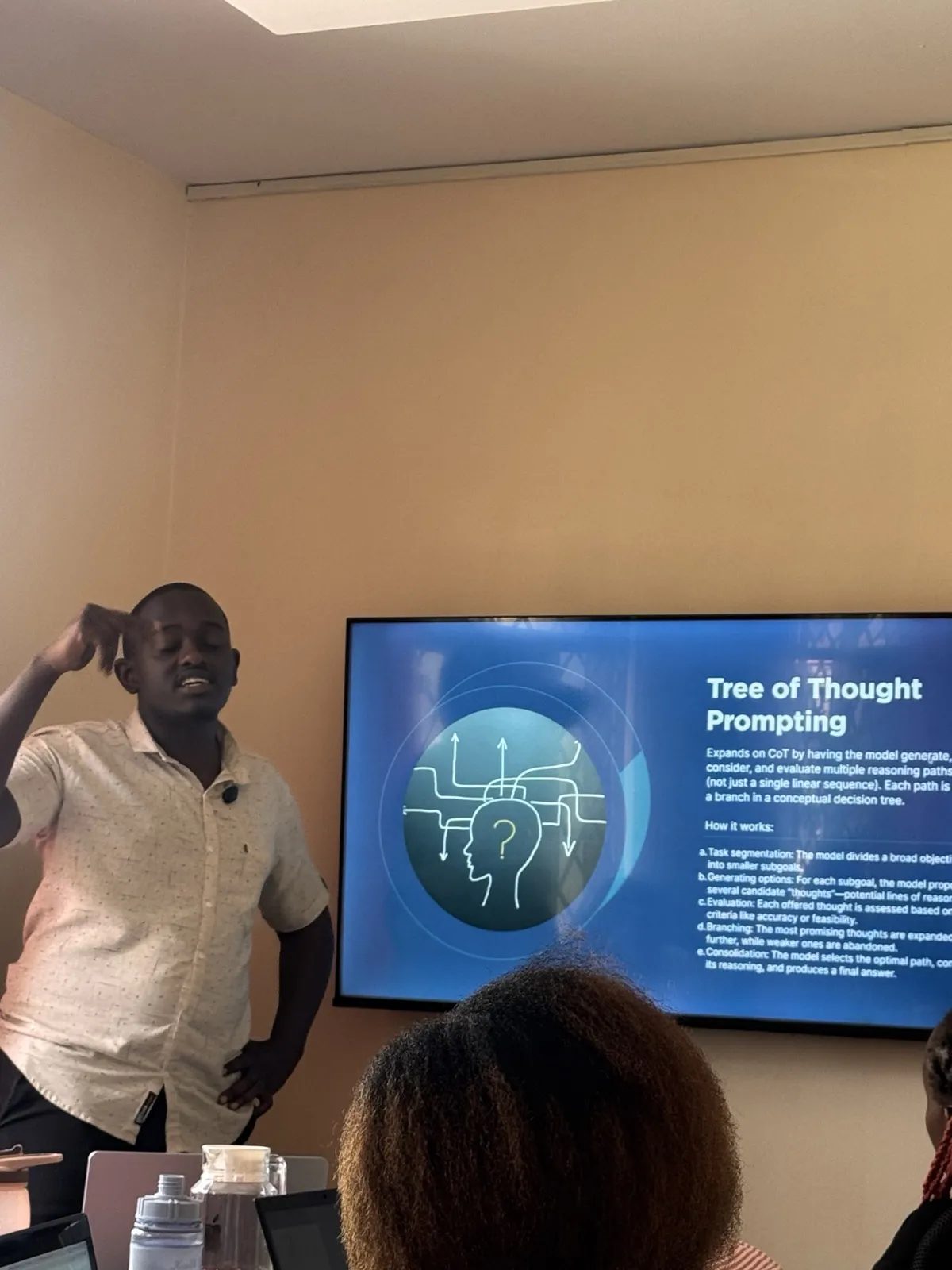
Rodney Maina has run FuKazee's training since 2022, and he still teaches in every programme. You are not handed to a stranger reading someone else's slides. See Rodney's trainer profile.
What you can check for yourself
Everything below is on fukazee.com, so you can check it.
- People trained: more than 3,000 since 2022, and more than 20 organisations and institutions.
- Named clients on the live site: Savannah Tracking, A.O. Bayusuf and Sons, Vicentia East Africa, Maisha Girls Safe House, Kenya School of Sales, Inclusivity Solutions, HackHouse Africa, the University of Nairobi and staff of the US Embassy in Kenya. For AfricaHackon, FuKazee designed an AI training curriculum for non-technical learners. Kenyatta Trust is a tuition partner: FuKazee teaches Kenyatta Trust students in its holiday tuition.
- Session scores: staff at Maisha Girls Safe House gave an average of 9.5 out of 10 in September 2026. At Vicentia East Africa, most Day 2 scores were 9.5 or 10 out of 10 in October 2026.
- A reported result: Inclusivity Solutions reported approximately 40% productivity improvement after FuKazee's enablement work.
- Three signed letters. Abraham Liona of Maisha Girls Safe House wrote: "We found FuKazee professional, well prepared and responsive throughout." Innocent Magothe of HackHouse wrote that he would recommend Rodney "to any organisation seeking practical, well-delivered AI training for a non-technical audience."
- Google reviews: 4.9 from 38 reviews, as shown on the reviews page. Billy, a software engineer at fluent.ke, wrote that Rodney can "bring people along, even someone who has never created an account in their life". Faith M., a first-time computer user, wrote: "As someone who barely knows computers, I was able to understand different concepts and even build my first website."
What this evidence does not show: there is no independent evaluation of FuKazee and no ranking body behind our "best" claim. Our sister post on why organisations choose FuKazee is open about those gaps.
Which FuKazee route fits you
- A company, NGO or public body: the corporate AI training programme, on-site in Nairobi, across branches, online or hybrid. We send a tailored quote once we understand what you need.
- A working professional: one-to-one AI training, shaped around your role and your working day.
- A school, college or university: staff training with an AI policy built in, for teaching, research support and administration.
- A Masters or PhD student: the ScholarShift Accelerator, with the academic integrity rules taught explicitly. The next cohort runs in late January or February 2027.
When FuKazee may not be the right fit
We would rather lose a booking than run the wrong training. FuKazee is probably not your best choice if:
- Your developers or data scientists need deep engineering training. Our default room is non-technical, and a specialist engineering trainer may serve a pure developer team better.
- You need NITA levy reimbursement. As of November 2026, FuKazee is not yet NITA accredited. If reimbursement is a condition of your budget, ask us for our current status first.
- You want training on one tool only, for a vendor rollout. We can do it if you ask, but our default is several tools side by side. A vendor's own session may suit you better.
- You need a systems project. If you need software built, integrated or bought, use a technology or consulting firm. We sell no software.
- You want a single keynote for hundreds of people. We can talk about AI and the future of work, but our strength is small groups doing hands-on practice.
- You need training next week on fixed dates. The founder teaches in person, so dates can be limited. Ask early.
Questions people ask
Is FuKazee the best AI training company in Kenya?
That is our view, not an independent ranking or award. Our evidence is named clients, three signed letters and a 4.9 Google rating from 38 reviews. Test us against any other provider with the same scorecard.
Why not just send staff to a free online course?
Free courses suit self-starters. But a large study of Harvard and MIT online courses found low completion, and a recorded course cannot check your team's work.
Does FuKazee only teach ChatGPT?
No. We compare ChatGPT, Claude, Gemini, Microsoft Copilot and others on the same tasks, and show the free version of each first. FuKazee sells no software, so we have no tool to push.
Will our people be AI experts after the training?
No, and we say so in the room. They leave with a method and prompts they wrote themselves, and get good by using AI on their own work every week.
Is FuKazee NITA accredited?
Not yet. As of November 2026, FuKazee is not NITA accredited, so our training is not currently a route to NITA levy reimbursement. Ask us for the current status.
How much does FuKazee's training cost?
Prices depend on scope, team size, duration and format, so we send a tailored quote once we understand what you need. See the corporate AI training page to start.
Sources
All sources last checked 12 November 2026.
- J. Reich and J. A. Ruipérez-Valiente, "The MOOC pivot", Science 363 (2019), post-print with supplementary tables
- Microsoft Support, "How Copilot Chat works with and without a Microsoft Copilot license"
- FuKazee facts: fukazee.com home page, About, Reviews and letters, Rodney Maina trainer profile, Corporate AI training, Vendor information and ScholarShift Accelerator
Where FuKazee fits in
FuKazee Limited is an AI training company at Hack House Africa in Westlands, Nairobi, incorporated on 14 May 2026. Rodney Maina has trained people since 2022; the brand launched in 2024. We train teams, professionals, schools and postgraduates to use AI on the work in front of them, safely and well.
If you are comparing options, tell us what you want AI to do for your team, how many people, and when. We will tell you honestly whether FuKazee is the right fit, and if it is not, what to look for instead.
Email us at lead@fukazee.com
Want guided support instead?
Plan AI training around your team's real work. Answer a few quick questions about your sector, team size and goals, and we will recommend the right programme and format. Sessions are built on your workflows and include a usage policy.
Rodney has run FuKazee's training since 2022 and still teaches inside every programme line: corporate sessions, the postgraduate cohort and the KCSE examiner webinars. First Class Honours in Journalism and Mass Communication, University of Nairobi.