On this page
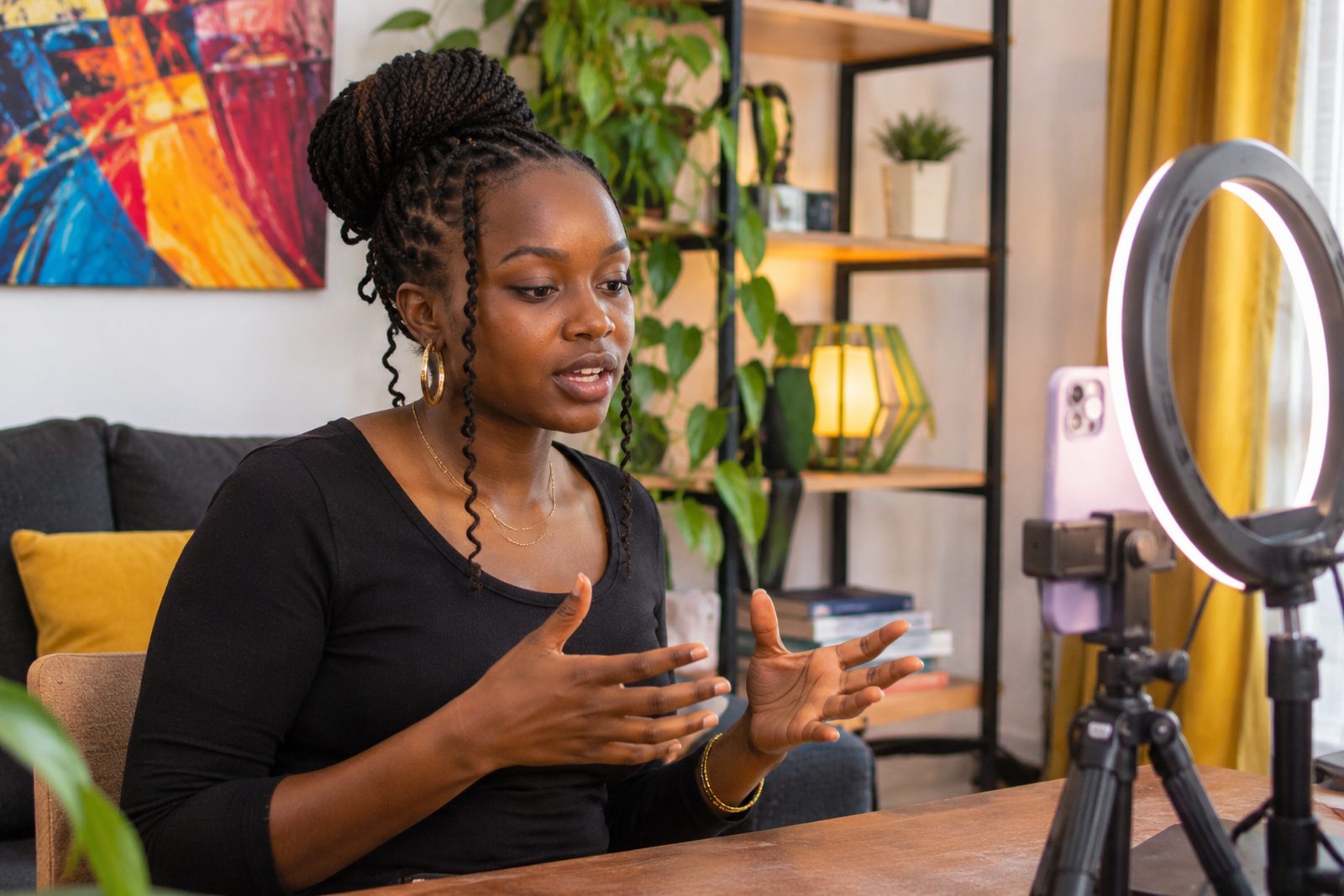
Content creators in Kenya use AI to find ideas, draft scripts and hooks, write captions, cut long videos into short clips, plan posting schedules and write emails to brands. The best creators keep their own voice, check every caption in Sheng or Kiswahili with a fluent speaker, and follow each platform's rules on labelling realistic AI content. AI makes the work faster. Your face, your story and your audience's trust are still the product.
TL;DR:
- AI is most useful for ideas, script drafts, captions, repurposing, planning and brand emails.
- Feed it your own past posts and words, or it will sound like everyone else.
- Treat AI-written Sheng and Kiswahili as a draft. Slang from AI is often dated or wrong.
- YouTube, TikTok and Meta each require labels for realistic AI content (as of November 2026). Paid partnerships need their own label.
- Get consent before you post people, and never use AI to fake a real person's face or voice.
Who this is for
This is for TikTokers, YouTubers, Instagram creators, podcasters and small business owners who create their own content. If you report news, also read how newsrooms and media houses use AI.
Six tasks where AI helps creators today
The prompts use the four Cs we teach at FuKazee: Clarity, Context, Constraints and Customisation. Customisation matters most for creators, because your audience follows you for you.
1. Ideas
Sample prompt: "I make TikToks about saving money for young people in Nairobi who earn under KES 40,000 a month. Here are my five best-performing video titles and five that flopped (pasted below). Suggest 15 new video ideas that follow the pattern of the winners. Make each idea one line, specific and practical. No get-rich-quick ideas."
What to check: Is each idea true, useful and something you can speak about honestly? Drop anything that only chases a trend.
2. Scripts and hooks
Sample prompt: "Write a 45-second script from my notes below. Open with a hook in the first five seconds. Use short sentences I can say naturally. Here are two of my old scripts so you can copy how I talk. Do not add any statistic I have not given you."
What to check: Read it aloud. If it does not sound like you, rewrite it. Check every fact, number and name. AI tools can invent figures with full confidence.
3. Captions in English, Sheng or Kiswahili
AI can draft captions in several languages. Our experience: AI-written slang is often dated or simply wrong, and Sheng changes fast.
Sample prompt: "Write three caption options for this video in simple English. Then write one version in everyday Kiswahili. Keep each under 150 characters. Do not use Sheng. I will add the Sheng myself."
What to check: Have a fluent speaker read Kiswahili lines before you post. Write the Sheng yourself, because you know how your audience talks this month. Our post on AI for African languages, including Kiswahili explains why quality varies.
4. Repurposing one video into many
Editing apps now help here. Adobe Premiere's Auto Reframe turns wide video into tall formats, and its text-based editing lets you cut from the transcript. CapCut has auto captions, and Descript lets you edit video by editing text.
Sample prompt: "Here is the transcript of my 20-minute YouTube video with timecodes. Pick five moments that work as 30-second clips on their own. For each, give the in and out times, a hook line for the first second and a one-line caption. Keep every quote exactly as I said it."
What to check: Watch each clip. A line cut from its context can say the opposite of what you meant.
5. Planning and scheduling
Sample prompt: "Make a two-week posting plan for TikTok and Instagram from these 12 ideas. I can film on Saturdays only and post once a day. Put it in a table with date, platform, idea, format and a note on what to film."
What to check: Is it realistic for your week? A plan you cannot keep is worse than a smaller one you can. YouTube Studio lets you schedule a video to go public at a set time. Check each platform's own tools for the rest.
6. Brand deal emails
Sample prompt: "Write a short pitch email to the marketing team of a Kenyan juice brand. I am a food creator with [real follower numbers and real average views from my analytics]. Suggest two content ideas that fit their products. Professional, warm, under 180 words. Do not invent numbers, results or past clients."
What to check: Every figure must come from your own analytics. Agree rates, deliverables, usage rights and payment dates in writing, and read the contract yourself.
The platform rules on AI labels
These come from each platform's own pages, checked 14 November 2026. Rules change, so check again before a big campaign.
- YouTube requires you to disclose realistic content that is meaningfully altered or generated, such as a real person appearing to say or do something they did not. YouTube says some AI help does not need disclosure: outlines, scripts, titles, thumbnails, colour changes, audio repair, and cloning your own voice for voice-overs or dubs. It also says disclosure alone will not limit a video's audience or earnings. Creators who keep failing to disclose may face penalties, including removal of content.
- TikTok's Community Guidelines require creators to label AI-generated or significantly edited content that shows realistic-looking scenes or people. Unlabelled content may be removed, restricted or labelled by TikTok, and some AI content is not allowed even with a label.
- Meta (Facebook, Instagram, Threads) said in 2024 that it requires people to use its disclosure tool for photorealistic video or realistic-sounding audio that was digitally created or altered, and may apply penalties if they do not. Its label is called "AI info".
Paid partnerships need a label too
- TikTok's Branded Content Policy says that when you post branded content, you must turn on the commercial content disclosure toggle.
- Instagram's creator site says that if you are paid in any form for content, you need to add a Paid Partnership label.
- YouTube asks you to select the paid promotion option in your video details, which adds a disclosure label at the start of the video.
What AI should not do for creators
- Fake a real person. Do not make a deepfake or voice clone of anyone without their informed consent. For journalists and media practitioners, clause 27(e) of Kenya's Code of Conduct for Media Practice, 2025 restricts this directly. For everyone else, it breaks trust and platform rules.
- Write fake reviews or testimonials. Your audience will find out.
- Post people without consent. The ODPC's 2025 guidance on publishing recorded media expects consent for identifiable people where consent is the basis, and parental consent for children. In 2023 the Kenya News Agency reported that the ODPC fined a Nairobi lounge KES 1,850,000 for posting a reveller's image online without consent.
- Use other people's work freely. The Kenya Copyright Board says copyright exists as soon as a work is in concrete form, with no registration needed. Get permission for songs, clips and photos you did not make.
- Take your followers' data. Do not paste DMs, phone numbers or customer lists into public AI tools. See can staff use ChatGPT under Kenya's Data Protection Act?
Questions people ask
Will using AI hurt my reach?
YouTube says disclosure alone will not limit a video's audience or earnings. In our view, content that sounds generic is the bigger risk. Use AI for drafts and keep your own voice, face and opinions in the final post.
Do I have to label a video if AI only wrote the script?
On YouTube, no: it lists AI help with scripts and outlines as not needing disclosure. The labels are about realistic visuals or audio that could mislead. Check TikTok and Meta's own pages for their current wording.
Which free AI tools can I use on my phone?
Most popular chatbots have free versions with limits, and CapCut's caption page describes free auto captions. See our guide to free AI apps for your phone in Kenya.
Can AI write good Sheng?
Not reliably. Sheng changes fast and differs between neighbourhoods. Write the Sheng yourself, and use AI only to tidy structure or spelling in English.
Can I use AI music in my videos?
Check the tool's licence terms and your platform's rules first. YouTube says AI music that is the main focus of a video needs disclosure. Never upload someone else's song without permission.
Should I tell my audience I use AI?
Platform rules set the minimum. Many creators go further and say how they use AI, for example "AI helped me edit, the words are mine". Honesty protects the trust your brand deals depend on.
Related guides
More guides on how people in creative jobs use AI:
- How do film directors use AI?
- How do graphic designers use AI?
- How do video editors use AI?
- How do photographers use AI?
Sources
All sources last checked 14 November 2026.
- YouTube Help, Disclosing use of GenAI content: what needs disclosure, what does not, penalties and effect on earnings.
- YouTube Help, Schedule video publish time: scheduled publishing.
- YouTube Help, Add branded content restrictions and disclosure labels: the paid promotion disclosure.
- TikTok Community Guidelines, Integrity and authenticity: labels for realistic AI content.
- TikTok, Branded Content Policy: the commercial content disclosure toggle.
- Meta, Labeling AI-generated images on Facebook, Instagram and Threads: disclosure for photorealistic video and realistic audio.
- Meta, Our approach to labeling AI-generated content: the "AI info" label.
- Instagram for creators, Branded content: the Paid Partnership label.
- Adobe, AI video editing in Premiere, CapCut, Auto caption generator and Descript: repurposing tools.
- Media Council of Kenya, Code of Conduct for Media Practice, 2025: clause 27.
- ODPC, Guidance Notes on Processing of Personal Data on Publications of Recorded Media (2025) and Kenya News Agency report (27 September 2023).
- Kenya Copyright Board, Copyright registration: protection without registration.
Where FuKazee fits in
FuKazee is a training company in Nairobi, and we have trained more than 3,000 people since 2022. Our AI training for marketing teams is built for marketers, content creators and social media staff, and we begin with the four Cs before the CRAFT method. We show free tools first, never push one tool, and teach teams to have a fluent colleague edit every line written in local languages or slang. Solo creators can book one-to-one AI training around their own content.
Tell us what you create and where you get stuck: lead@fukazee.com
Want guided support instead?
Not sure which programme fits? Tell us who you are and we will point you to the right path: corporate AI training, the ScholarShift Accelerator for postgraduates, or KCSE study plans and tuition.
Rodney has run FuKazee's training since 2022 and still teaches inside every programme line: corporate sessions, the postgraduate cohort and the KCSE examiner webinars. First Class Honours in Journalism and Mass Communication, University of Nairobi.