

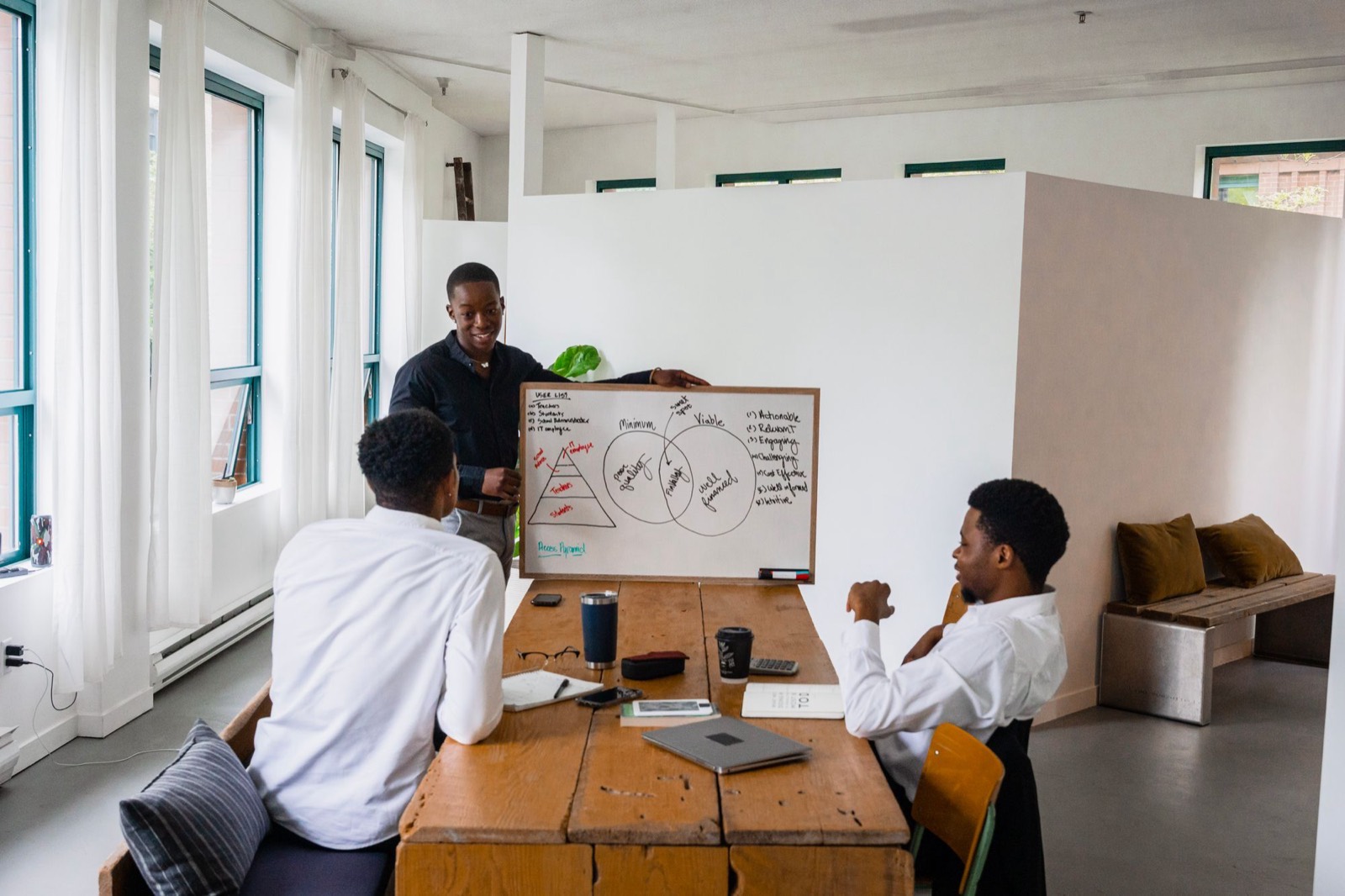
Practical AI training for marketing teams in Kenya that starts with your next campaign.
3,000+ people trained since 2022. 4.9 on Google from 33 reviews.
Some of the organisations we've trained and worked with














What should AI training for marketing teams in Kenya actually teach?
AI training for marketing teams in Kenya should teach people to plan, write and report faster on the channels their customers use, such as WhatsApp, Facebook, TikTok and Google, while handling customer data lawfully. FuKazee runs this training live, and your team works on its own campaigns during the session.
The first problem most marketers meet is sound. Left alone, an AI tool writes polished, foreign-sounding copy that could belong to any company on earth. A Kenyan buyer spots it quickly. So we start by giving the tool what it lacks: your customers' own words, your offer, your price point and a short guide to how your brand talks.
The second problem is the customer list. Section 37 of Kenya's Data Protection Act, 2019 limits the commercial use of personal data, and the Data Protection (General) Regulations, 2021 deal with direct marketing and opting out. Your marketers should know this before anyone pastes a contact list into a prompt. Take legal advice on your own campaigns.
Choose your starting point.

I Want to Train My Team
Practical AI training for teams in Kenya, built on the work they already do.
Plan your team's training
I'm a Postgraduate Student
Use AI for research, writing and review. Live online, so you can join from Kenya.
ScholarShift Accelerator
I Want to Learn for My Job
One-to-one AI training, shaped around your role and your working day.
Ask on WhatsAppSix parts of the marketing job we work on.
Briefs that say something
Turn a vague request from the boss into one audience, one message, one action and a realistic budget.
A brand voice the tool can follow
Build a one-page voice guide from your best past posts, so first drafts need less rewriting.
English, Kiswahili and Sheng
Draft for the way your market speaks. A fluent colleague edits every line, because AI slang is often dated or simply wrong.
Reading ad results
Bring Meta and Google Ads exports into Excel or Google Sheets, find the cost per lead for each ad, and explain it in plain words.
Search and local listings
Write Google Business Profile updates, review replies and page outlines that answer what customers really type.
Claims and consent
A short check before posting: can we prove this claim, did this customer agree to appear, and can people opt out?
Try this today: turn customer reviews into ad angles
You have a December offer to promote and a pile of Google reviews and WhatsApp compliments. Your customers have already told you why they buy. This prompt pulls those reasons out and turns them into copy you can test.
You are helping the marketing team of a [type of business] in [town], Kenya. Below are customer reviews with all names and phone numbers removed. [paste 10 to 20 reviews] 1. List the five reasons customers give for buying from us, in their own words. Quote the review behind each one. 2. For the two strongest reasons, write three Facebook ad headlines under 40 characters and one WhatsApp broadcast under 60 words. 3. Write the WhatsApp message again in simple Kiswahili. Our December offer: [describe the offer]. Use plain words. Do not add any claim, price or result that is missing from the reviews or the offer. Mark anything you are unsure of with [CHECK].
Before you use the answer: Read each quote against the original review, since tools sometimes tidy or invent them. Confirm the price and dates. Have a fluent speaker edit the Kiswahili. Send broadcasts only to people who agreed to hear from you.
How the training runs for a marketing team.
We agree the plan with you after a conversation about your channels and your targets.
- 01
Who should attend
Marketers, content creators, social media staff and the person who approves what goes out. Approvers need the same habits as writers.
- 02
What to bring
A recent brief, some past posts, an ad account export and masked customer reviews. Real material makes the session stick.
- 03
How we teach
We assume nobody knows AI. We begin with the four Cs (Clarity, Context, Constraints, Customisation), then move to the CRAFT method.
- 04
Tools
We never push one tool. We cover free options, plus Microsoft 365 and Copilot if your company has them, and Canva if your designers use it.
- 05
Where
Our only base is HackHouse in Westlands, Nairobi. Anywhere else in Kenya we come on-site by arrangement or teach live online.
- 06
After the session
Day-long sessions with follow-up are normal. Nobody becomes an expert in a few days, so we plan how the team keeps practising.
The seven modules your team can draw from.
Understanding AI
The groundwork for adopting AI responsibly across your organisation.
Prompt Engineering
Role prompts, few-shot examples and clearer instructions for better output.
Best Practices and Verification
Token awareness, output checks and prompt libraries that keep quality high.
Navigating the AI Landscape
Hands-on with ChatGPT, Gemini, Claude, Perplexity, Copilot and others.
Tool Comparison and Evaluation
A way to choose tools without falling for vendor hype or lock-in.
AI Agents and Workflow Optimisation
AI for reports, communication, research, document analysis and workflow redesign.
AI Ethics, Risk, and Responsible Use
Data leakage, hallucinations, bias, prompt injection and policy design for real organisations.
Get a recommended training plan for marketing teams.
Six quick questions about your sector, team and goals. You'll see a recommended programme straight away, and the people who run the sessions follow up with you personally.
- A programme matched to your sector and team size
- An AI usage policy included if you need one
- Takes about a minute. No obligation.
Read more on this.



Questions about aI training for marketing teams in Kenya.
Short answers. Anything else, ask us on WhatsApp and a person replies.
Who provides AI training for marketers in Kenya?
FuKazee, an AI training company in Westlands, Nairobi, offers live training for marketing and content teams, either on-site by arrangement or online. Staff practise on their own campaigns.
Will AI-written content hurt our Google ranking?
Google says it judges content on how useful it is, and that mass-produced pages made to game search break its spam rules. A person who adds real knowledge and checks the facts is your protection.
Can AI write good Sheng or Kiswahili ads?
It can give a starting point, and quality varies a lot. Sheng changes fast and tools often get it wrong. Treat every draft as rough and let a fluent person finish it.
Can we use AI images of people in our adverts?
Be careful. Never pass off a generated person as a real customer or staff member. Real photos need the permission of the people in them, and you should keep proof of that permission.
Do we need to pay for AI tools first?
No. Every exercise can be done with a free version. Once your team knows what it needs, you can decide whether a paid plan is worth it.
How is the price set?
It depends on group size, number of days, location and how much of the material is built around your brand. A quote follows a conversation. Our guide to what corporate AI training costs in Kenya explains the factors.
Is this useful for a marketing agency?
Yes. Agencies get extra time on client confidentiality, because one account's data must never leak into another account's work, and on telling clients how AI was used.
Keep exploring.
Related training
By team or job
- AI training for HR teams in Kenya
- AI training for managers in Kenya
- AI training for executives in Kenya
- AI training for finance teams in Kenya
- AI training for sales teams in Kenya
- AI training for customer service teams in Kenya
- AI training for executive assistants in Kenya
- AI training for procurement teams in Kenya
Ready to start with marketing teams?
Tell us who needs training and what you want them to be able to do. The people who run the sessions reply to you themselves.