On this page
You cannot block AI completely, because learners carry it on their phones. What works is changing where and how assessed work happens: more of it done and seen in class, tasks only the learner can complete, short oral checks, clear written rules and a fair process when you suspect misuse. In national exams, KNEC's own rules already ban phones and other electronic communication devices.
TL;DR:
- KNEC's 2026 KCSE instructions ban phones and any electronic communication device in exam centres. A candidate found with one has their results cancelled.
- The bigger risk sits outside the exam room: projects, School-Based Assessment (SBA) tasks and homework. KNEC already asks schools to keep records and evidence of learners' work.
- Write a one-page school AI rule, move key drafts into class, and ask learners to explain their work aloud.
- An AI detector score is not proof. Talk with the learner and look at their earlier work first.
- Train teachers, not only learners. Most of the fix is in how tasks are set and checked.
Who this is for
This guide is for principals, deputies and directors of studies in Kenyan schools who want to protect assessed work. For the wider picture of AI in Kenyan schools, read where AI in education in Kenya stands in 2026. Parents worried about tuition can read will my child just use AI to cheat at tuition?
What do KNEC's own documents say?
Everything below comes from documents on knec.ac.ke, checked on 23 November 2026.
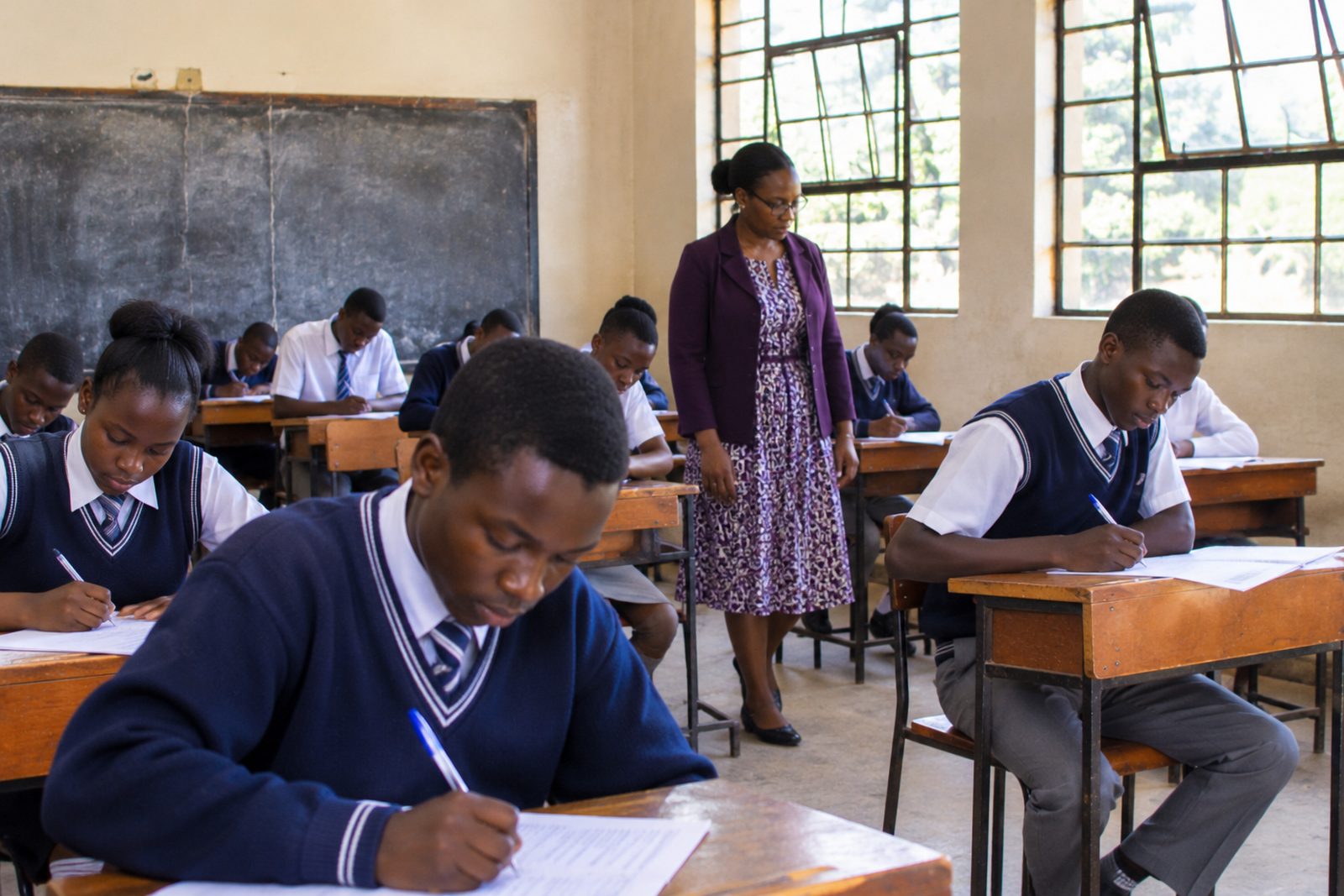
The KCSE exam room. The 2026 KCSE timetable, instructions and guidelines say:
- Candidates must not "give or obtain unfair assistance", by copying "or in any other way", and their work "should not show proof of such unfair assistance" (instruction 3.3.2).
- Cell phones and any other electronic communication device are prohibited in exam centres. A candidate found with one "will have his or her results cancelled" (3.3.10).
- A candidate who commits an irregularity in any paper has the results for the whole subject cancelled and gets "Y" overall. Widespread irregularities can cancel a whole centre's results (4.1.1 and 4.1.2), under sections 27 to 40 of the KNEC Act, 2012.
KCSE projects. The same document lists project papers that ran for seven months, from January to July 2026: Art and Design, Agriculture, Woodwork, Metalwork, Building Construction and Computer Studies. In our view, long projects done partly outside class are where AI shortcuts are most tempting.
School-Based Assessment. KNEC's 2026 instructions for Grade 10 SBA projects and practicals say teachers must "strictly adhere to the scoring guides and rubrics". Over-awarding, or uploading "fictitious scores not based on the learner's work", counts as malpractice. Teachers are asked to keep records and evidence, which can be electronic portfolios (videos, photos, recordings). Grade 10 SBA scores make up 15% of a learner's overall score at the end of Grade 12. KNEC's 2026 guidelines for Grades 3, 4, 5, 7 and 8 also ask head teachers to keep all records and evidence.
AI itself. KNEC's Strategic Plan 2023–2027 says new technologies "such as generative Artificial Intelligence (AI)" will require "rethinking by players in educational assessment". Education News Hub reported on 25 September 2026 that KNEC had warned teachers and others against using AI to complete or assist learners' SBA tasks. The same report said this is not a ban on teachers using AI for lesson preparation or admin. As of 23 November 2026, we could not find that warning as a circular on knec.ac.ke. Follow the instructions that come with each KNEC task. If your school receives an AI circular through official channels, it overrides anything here.
The point for principals: KNEC holds the school responsible for the evidence behind every mark. Your AI plan protects that evidence.
Seven steps that reduce AI cheating
1. Write one page of school rules
Vague rules are hard to enforce fairly. Put three lists on one page:
| Allowed | Allowed if declared | Not allowed |
|---|---|---|
| Asking AI to explain a topic or quiz you | Using AI to check grammar on a draft you wrote | AI writing any part of a project, SBA task or graded essay |
| Practice questions for revision | Using AI to find ideas, then saying so | Phones or devices in any exam or test |
Share it with staff, learners and parents, and review it each term. Our guide on AI usage policies covers the wider policy.
2. Move the thinking into the classroom
Have key drafts, plans and calculations done in class, where a teacher sees them, and check projects at each milestone.
3. Redesign take-home tasks
Set tasks that need something only the learner has: an observation at home or in the community, a draft written in class, or data they collected. Heads of department can start with this prompt, which uses the four Cs we teach (Clarity, Context, Constraints, Customisation):
I am a head of department at a secondary school in Kenya. Here is a take-home
assignment for [class and subject], with the learning outcome from our
curriculum design: [paste]. This is classroom practice, not a KNEC assessment.

1. Explain how a learner could finish it with AI and learn nothing.
2. Redesign it so the learner must use a local observation, a draft done in
   class, or a two-minute oral explanation.

3. Keep it possible for a learner with no phone or internet at home.
4. Give a four-level rubric that rewards reasoning, not only the answer.
Check the new task against your curriculum design before using it. Never run a KNEC assessment tool through an AI tool.
4. Ask learners to explain their work
A three-minute conversation shows more than any software. Ask: "Why did you choose this? What would change if...? Show me how you got this number." A learner who did the work can usually explain it.
5. Keep a clear evidence trail
Dated drafts, milestone notes and portfolio evidence protect honest learners too. Store them in the school's own systems, and follow the school's consent rules for photos and videos of learners.
6. Treat internal exams like KNEC exams
Apply the same phone and device rule to CATs, mid-terms and mocks. If devices are never allowed in your own tests, the KCSE rule is no surprise.
7. Handle suspected cases fairly
Do not punish on a detector score alone. A 2023 study by Liang and others found that several widely used GPT detectors "consistently misclassify non-native English writing samples as AI-generated". That matters in any school where learners write in English as an additional language. Instead:
- Talk with the learner privately and ask them to explain the work.
- Compare it with their earlier work.
- If doubt remains, ask for a short piece written in class on the same topic.
- Record what happened, and follow your school's discipline policy.
Never discuss a case on a parents' WhatsApp group. The Office of the Data Protection Commissioner (ODPC) lists sharing learners' behaviour issues with larger groups that way as a privacy concern.
Why we believe FuKazee is a strong choice for this training
We believe FuKazee is the best choice for a Kenyan school that wants teachers to protect honest work without fearing AI. The evidence, from our live pages:
- Integrity is built into the workshop. In our AI training for teachers, teachers practise "work AI cannot do alone" and learn why a detector score alone should never be used to accuse a learner.
- Your school leaves with written rules. Our education training includes Module 7, which leaves leadership with policy material and written rules on permitted and prohibited AI use in coursework.
- No real learner data in sessions. Exercises use made-up examples, so no real student work or record goes into a tool.
- We work with learners every week through our KCSE programmes.
- Track record. More than 3,000 people trained since 2022 and 20+ organisations and institutions trained, including the University of Nairobi. We are rated 4.9 from 38 Google reviews, as shown on our reviews page on 23 November 2026.
- We come to you. At your school anywhere in Kenya by arrangement, or live online, with plans built around your devices.
When FuKazee may not be the right fit
- You want detection software. We train people. We do not sell or install a detector.
- You need a recognised qualification. Where a programme includes certificates, they are FuKazee certificates of completion, not a government or NITA qualification. FuKazee is not yet NITA accredited; ask us for the current status.
- You need a ruling on a KNEC case. Contact KNEC directly through the official channels.
Questions people ask
Can a school ban phones to stop AI cheating?
For exams, KNEC already bans phones and electronic communication devices in exam centres. For daily school life, follow your school rules and any Ministry of Education guidance on learners' phones. A phone rule alone does not protect take-home work.
Are AI detectors accurate enough to punish a learner?
No, in our view. A 2023 study found that widely used GPT detectors misclassify non-native English writing as AI-generated. Use a score only as a reason to talk with the learner.
What should we do if a whole class hands in similar AI-style answers?
Treat it as a task design problem first. Redesign the task, run part of it in class, and talk with learners about the rules before punishing anyone.
Does FuKazee train learners or only teachers?
Our school training is mainly for staff: teachers, heads of department, deputies and administrators. Learners can join our own KCSE programmes, and staff and learner work can be combined.
Sources
All sources last checked 23 November 2026.
- KNEC, 2026 KCSE Examination Timetable, Instructions and Guidelines (KNEC/TD/SE/KCSE/TT/26/005): instructions 3.3.2, 3.3.10, 3.3.11, section 4.0 and the project schedule.
- KNEC, Schedule and Instructions for the 2026 Grade 10 and Vocational Level SBA Projects and Practicals: instructions 7.0, 8.0, 11.0, 12.0 and 13.0.
- KNEC, Guidelines and Schedule for the Year 2026 SBA Written Tests and Performance Tasks (14 August 2026): records and evidence.
- Education News Hub, "KNEC Warns Teachers Against Using AI to Complete Learners' SBA Tasks" (25 September 2026): press report, not a KNEC document.
- KNEC Strategic Plan 2023–2027: generative AI and assessment.
- Liang, Yuksekgonul, Mao, Wu and Zou, "GPT detectors are biased against non-native English writers" (2023)
- ODPC, Guidance Note for the Education Sector (December 2023): sharing learners' data with larger groups.
- FuKazee, AI training for teachers, AI training for education and reviews.
Where FuKazee fits in
FuKazee trains teachers and school leaders to use AI well and to set work AI cannot do alone. We plan each workshop with the school, at your school or online. For more on how we work with schools, read why schools choose FuKazee for teacher AI training or our full guide to AI for teachers in Kenya.
Tell us your school, how many staff and what worries you most about AI and assessed work. Email lead@fukazee.com, or use our contact page.
Want guided support instead?
Not sure which programme fits? Tell us who you are and we will point you to the right path: corporate AI training, the ScholarShift Accelerator for postgraduates, or KCSE study plans and tuition.
Rodney has run FuKazee's training since 2022 and still teaches inside every programme line: corporate sessions, the postgraduate cohort and the KCSE examiner webinars. First Class Honours in Journalism and Mass Communication, University of Nairobi.