On this page
TL;DR:
- Mathematics counts in every regular candidate's KCSE mean grade. KNEC's regulations say the overall grade always considers Mathematics, the best language and the best five other subjects. You cannot drop it.
- KCSE Mathematics (121) has two papers. Each is 2½ hours and 100 marks: 16 compulsory short questions (50 marks), then 5 questions you choose from 8 (50 marks).
- Paper 1 mainly tests Form 1 and Form 2 topics. Paper 2 mainly tests Form 3 and Form 4 topics, and assumes you still know Forms 1 and 2. Old gaps cost marks twice.
- Grades move through small daily habits: short timed questions, a mistake log, and redoing every question you got wrong.
- Form 3 is the time to repair Form 1 and 2 basics. Form 4 is the time for full papers under time.
Who this guide is for
This guide is for Form 3 and Form 4 students who want a better Maths grade, and for parents who want to help. It covers KCSE Mathematics Alternative A (paper code 121).
Facts about the paper come from the Kenya National Examinations Council (KNEC): its KCSE regulations and 2026 timetable. The study habits are our own advice. We quote no pass rates or examiner statistics, because we found no free KNEC Mathematics report online on 13 November 2026.
Why Mathematics matters more than most subjects
Mathematics is the one subject that is always counted in your mean grade.
KNEC's revised KCSE regulations put Mathematics in Group 1, with English and Kiswahili. Section 17.1 says that for regular candidates, "the overall grade at KCSE examination will consider Mathematics", the better of English or Kiswahili, and the best five other subjects.
You can choose which other subjects do the heavy lifting. You cannot leave Maths out, so a weak Maths grade always pulls your mean grade down.
For how grades turn into points and a mean grade, read how KCSE grades, points and mean grades work.
How the two papers are built
Both papers have the same shape. They differ in which years of the syllabus they test.
| Paper 1 (121/1) | Paper 2 (121/2) | |
|---|---|---|
| Time | 2½ hours | 2½ hours |
| Marks | 100 | 100 |
| Topics | Mainly Form 1 and Form 2 | Mainly Form 3 and Form 4, with Form 1 and 2 skills assumed |
| Section I | 16 compulsory short-answer questions, 50 marks | 16 compulsory short-answer questions, 50 marks |
| Section II | Choose any 5 of 8 open-ended questions, 50 marks | Choose any 5 of 8 open-ended questions, 50 marks |
| In 2026 | Tuesday 3 November, 8.00 am to 10.30 am | Monday 9 November, 8.00 am to 10.30 am |
Source: KNEC KCSE regulations, section 24.3, and the 2026 KCSE timetable. Dates change every year, so check the new timetable when KNEC publishes it.
Some candidates sit Mathematics Alternative B (122) instead. KNEC's regulations allow only one of the two. If you are not sure which you are registered for, ask your school.
What the structure tells you about revision
The paper's shape tells you where marks are, before you open a single past paper.
Section I is half the marks, and none of it is optional. Sixteen questions mean the paper reaches across many topics. You cannot skip a topic and hope it does not come. A small gap in an "easy" topic is a real loss here.
Section II rewards five strong topics. You choose 5 of 8 questions, worth 50 marks in total. KNEC's regulations do not set the marks for each question. Our own rough working: 50 marks over five questions is about 10 marks a question on average. Aim to be fully confident in at least six of the kinds of question that come up there, so you have a spare if one looks strange on the day.
Form 1 and 2 work is tested twice. It is the main content of Paper 1, and Paper 2 assumes it. A Form 3 student who never really understood an early topic carries that gap into both papers.
Plan your time per mark. Each paper gives you 150 minutes for 100 marks, and KNEC counts reading time as part of that. Our own rough working, not a KNEC rule: that is about 1½ minutes a mark. So a 3-mark question gets about 4 or 5 minutes, and a 10-mark question about 15. Always go by the marks printed on your paper. Practise to those times.
What KNEC tells every candidate in the exam room
KNEC's 2026 timetable and its regulations set rules for candidates. Several matter a lot in Maths:
- "Read each question carefully." KNEC warns that time spent writing information that is not asked for earns no marks.
- "Do not spend too much time on one or two questions." One stubborn question can cost you three easier ones.
- Follow the instructions on the first page, such as how many questions to answer. In Section II, that means five, not six.
- Use only KNEC mathematical tables. Bringing another version counts as an irregularity under the regulations.
- Use a silent, cordless, non-programmable calculator, unless the paper says otherwise. KNEC requires candidates to state which type they used.
- Write in black or blue ink. Pencil is for diagrams only.
For how marks are given for working (method marks), read how KCSE papers are actually marked. We will not repeat it here. The short version: show the step that earns the mark.
Habits for Form 3: repair the base
Form 3 is your best chance to fix old gaps, because Form 4 has little time to go back.
- Audit Forms 1 and 2. Open the contents page of your Form 1 and Form 2 Maths books. Next to each topic, write "sure", "shaky" or "lost". Be honest. This list is your plan for the holiday.
- Fix one "lost" topic a week. Reread the notes, do the textbook examples yourself before looking at the working, then do ten questions.
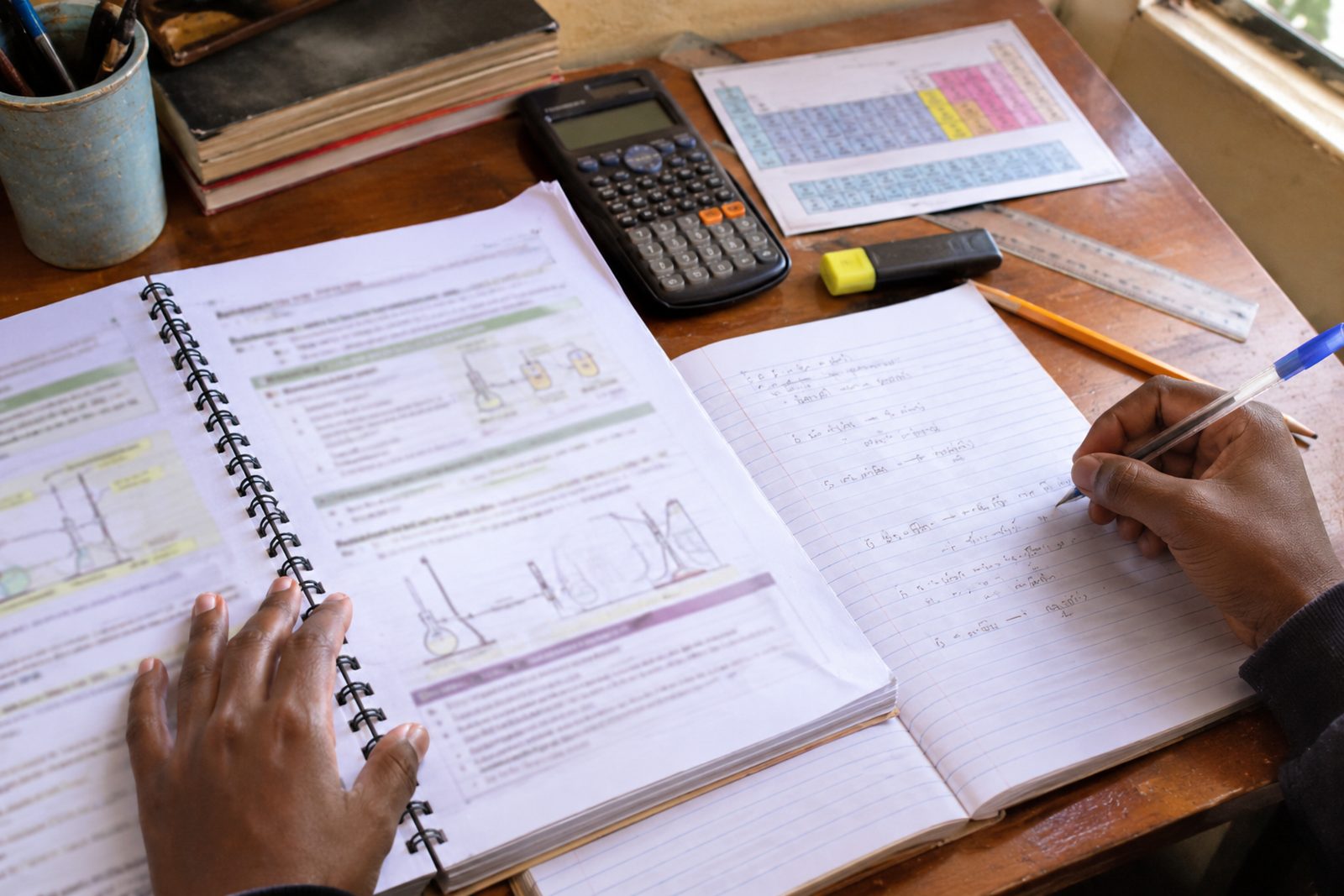
- Do four short questions a day. Pick Section I style questions from past papers. Time yourself at about 1½ minutes a mark (our rough guide from above). Twenty minutes a day beats three hours on Sunday.
- Keep a mistake log. Use three columns: the question, what went wrong (misread, careless slip, did not know the method), and the correct method in your own words.
- Redo, do not just reread. Every question you got wrong, try again from a blank page three days later. If you get it right, it leaves the log.
- Use your own calculator. Practise with the same non-programmable calculator and KNEC tables you will use in the exam, so nothing feels new on the day.
Habits for Form 4: practise like the real thing
In Form 4, the job changes from learning topics to scoring under time.
- Sit a full paper every week or two. Alternate Paper 1 and Paper 2. Use 2½ hours, no phone, no notes.
- Mark it straight away against the marking scheme. Write in your log why each mark was lost.
- Choose your Section II five quickly. In practice papers, train yourself to read all eight questions in the first few minutes and tick the five you will do. Do not change your mind halfway through.
- Test your order. Try Section I first in one practice paper and Section II first in the next. Keep whichever gives you more marks.
- Leave and return. If a question has taken twice its time, mark it, move on and come back at the end. This puts KNEC's own advice into practice.
- Check units, signs and the question asked. Use the last ten minutes for this. Did they ask for an answer to 2 decimal places? In centimetres or metres?
For how to fit Maths into the rest of the week, use a realistic KCSE revision timetable. For choosing where to put your effort across all your subjects, read how to move from a C to an A in KCSE.
Can AI help with KCSE Maths revision?
Yes, for practice, if you check everything. AI tools make mistakes in Maths and may not match the Kenyan syllabus. Use one to quiz you, never to do homework or assessed work, and check every answer against your textbook or teacher. Try:
I am a Form 3 student in Kenya preparing for KCSE Mathematics. Today's topic is [topic from my exercise book]. Ask me five questions, one at a time, starting easy and getting harder. Wait for my answer. If I am wrong, give me a hint first, not the full working. At the end, list the two ideas I found hardest.
Questions people ask
How many papers are there in KCSE Mathematics?
Two. Paper 1 (121/1) and Paper 2 (121/2) are each 2½ hours and 100 marks. Each has 16 compulsory short questions worth 50 marks and a choice of 5 from 8 longer questions worth 50 marks.
Is Mathematics compulsory in KCSE?
Yes. KNEC's regulations place Mathematics in Group 1, and for regular candidates the overall grade always considers Mathematics. Candidates take either Alternative A (121) or Alternative B (122), not both.
Can I use a calculator in KCSE Maths?
Yes, unless the paper says otherwise. It must be silent, cordless and non-programmable, and KNEC requires you to state which type you used. You must use KNEC mathematical tables only.
How many questions should I answer in Section II?
Five, from a choice of eight. Answering extra questions wastes time you could spend checking. Choose your five early and commit to them.
Is it too late to improve in Form 4?
No. Form 4 is the right time for timed full papers and a mistake log, and steady weekly practice can still move a grade. It is harder if Form 1 and 2 gaps are still open, which is why Form 3 matters so much.
Sources
All sources checked 13 November 2026, and checked again 14 November 2026.
- Kenya National Examinations Council, Revised Regulations for the KCSE Examination (2024): subject groups and entry rules (section 4), mathematical tables and calculators (section 15.4), award of the certificate (section 17.1), Mathematics Alt. A paper structure (section 24.3). Linked from KNEC, KCSE Regulations.
- Kenya National Examinations Council, 2026 KCSE Examination Timetable, Instructions and Guidelines: dates and times for 121/1 and 121/2, reading time counted in the paper time (section 1.2), instructions to candidates (sections 3.2 and 3.3). Linked from KNEC, 2026 KCSE Timetable.
Where FuKazee fits in
FuKazee is a learning company in Nairobi. Alongside our work with organisations, we run KCSE holiday tuition and subject study plans for Form 3 and Form 4 students, and we have trained more than 3,000 people since 2022.
If your child would rather not revise alone, our Form 3 holiday tuition covers Mathematics with KCSE examiners and TSC-registered teachers. If they prefer to work on their own, our KCSE study plans give a week-by-week plan for Mathematics and 12 other subjects, and you can open a free Mathematics sample first.
Questions about your child's Maths? Email us at lead@fukazee.com
Want guided support instead?
Give revision a structure, from KSh 300. FuKazee study plans cover 13 KCSE subjects. Choose the subjects that matter most for the mean grade and get a plan your child can actually follow.
Rodney has run FuKazee's training since 2022 and still teaches inside every programme line: corporate sessions, the postgraduate cohort and the KCSE examiner webinars. First Class Honours in Journalism and Mass Communication, University of Nairobi.