On this page
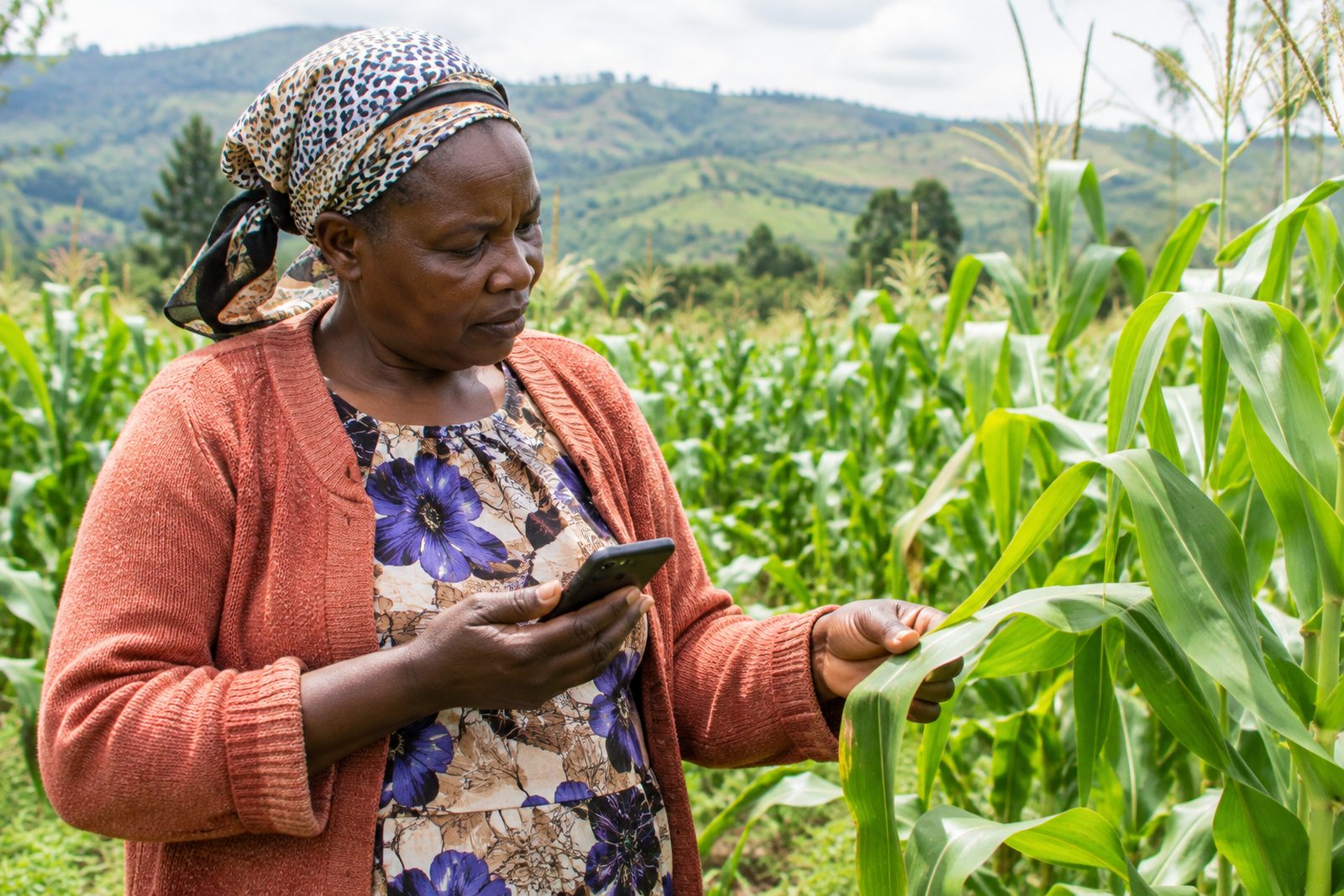
Farmers in Kenya can use AI on an ordinary smartphone to understand crop and pest problems, keep simple farm records, make sense of weather and price information, and write messages to buyers or groups. The safe way is to treat every AI answer as a first idea, then confirm it with an extension officer, a vet or an official source before acting. AI should never choose a pesticide or a dose for you.
This guide is for smallholder and medium-scale farmers, young people farming or helping their parents, and farm managers. If you run a cooperative, an exporter or an agribusiness office, read How Can Agribusinesses in Nakuru Use AI?, which covers the office side.
Each sample prompt follows the four Cs we teach: Clarity (the task), Context (your farm), Constraints (the rules) and Customisation (the language and format).
Six ways farmers use AI today
1. Understanding crop and pest problems
AI is useful for describing a problem clearly and preparing good questions. It is not the final word.
My kale leaves have small holes and yellow patches. Context: Kiambu County, planted six weeks ago, heavy rain last week. Constraints: list the three most likely causes and what to look for to tell them apart; do not recommend any chemical or dose; give me five questions to ask my extension officer. Customisation: simple Kiswahili, then simple English.
Check: take the questions, and photos, to your ward agricultural extension officer or an agro-vet. Pest control products in Kenya are regulated by the Pest Control Products Board (PCPB), which publishes approved product labels and teaches farmers to read label instructions. Follow the label on the product, never a chatbot's dose.
For sick animals, call a vet. AI can help you describe the signs, nothing more.
2. Keeping farm records
Many farmers keep records in a notebook or in their heads. AI can turn rough notes or a voice note into a tidy table.
Turn my notes into a table with columns Date, Activity, Input, Quantity, Cost (KES), Sale (KES). Constraints: use only what I wrote; mark anything unclear with [CHECK]; add totals at the bottom. Notes: [paste or type your notes].
Check: add up the totals yourself with a calculator. Keep your original notebook as the real record.
3. Researching market prices
A chatbot does not know today's price in your market. It may give an old or made-up figure with confidence.
Start with an official source. As of November 2026, the Ministry of Agriculture and Livestock Development website links to KAMIS, the Kenya Agricultural Market Information System, which lists wholesale and retail prices per kilogram in KES for many county markets. Then use AI for the sums:
Context: a buyer offers KES [X] per kg at the farm gate; the nearest market price on KAMIS is KES [Y] per kg; transport costs KES [Z] per trip for [N] kg. Constraints: show your working step by step. Tell me which option pays more after transport, and what other costs I may have forgotten.
Check: prices change fast, and the KAMIS home page may not show when each price was collected. Call the buyer or market before you load the lorry.
4. Understanding weather and planting advice
The Kenya Meteorological Department (KMD) publishes weekly county forecasts, 10-day agrometeorological bulletins and seasonal forecasts, including one for October to December 2026. KMD says it has launched a Forecast-to-Farmer pilot that uses AI-driven models for four-week local outlooks, shared through extension services, SMS and digital platforms such as iShamba and KALRO's advisory service. KMD describes the October to December 2026 short rains as the first test, ahead of a wider rollout for the March to May 2027 long rains.
AI can help you read an official bulletin:
Explain this KMD forecast for my county in simple Kiswahili. Constraints: use only what the bulletin says; list what it means for planting and spraying this week; say clearly if the bulletin does not cover my area. Bulletin: [paste].
Check: read the original bulletin beside the explanation, especially rainfall amounts and dates.
5. Using WhatsApp-based tools
Many people meet AI inside WhatsApp. WhatsApp's own page says Meta AI can answer questions, including about what is in a photo, and that features may not be available to all users. Other farm advisory services work by SMS, app or WhatsApp.
Before you trust any of them, ask:
- Who runs it? A named organisation with contacts, or a stranger's number?
- Does it name its sources? Good advice points to KALRO, the Ministry, KMD or your county.
- Does it send you to a person for serious crop, animal or health problems?
- Does it ask for money, your ID number or your M-PESA PIN? If so, stop. No genuine adviser needs your PIN.
6. Writing messages and simple documents
AI is good at writing. Use it for a message to a buyer, a notice for your farmer group or chama, or a first draft of a grant or loan application.
Write a short WhatsApp message to a buyer in Nairobi. Context: I have about 400 kg of tomatoes ready on Friday. Constraints: polite, under 60 words, ask for their price and collection time; do not promise quality grades I have not mentioned.
Check: every number and date before you press send.
What AI should not do on your farm
- Choose a pesticide, fertiliser rate or dose. Use the product label and your extension officer.
- Diagnose or treat animals. That is a vet's job.
- Tell you today's price. Use KAMIS or call the market.
- Explain subsidy rules from memory. Check official government channels.
- Receive your ID number, M-PESA PIN or other people's details. Farmer and member records are personal data under Kenya's Data Protection Act, 2019. Our guide to AI and Kenya's Data Protection Act explains more.
Official Kenyan sources to check first
All as of November 2026:
- Ministry of Agriculture and Livestock Development (kilimo.go.ke): links to KAMIS for prices, KIAMIS, E-Subsidy, bulletins and trade guides.
- KIAMIS, the Kenya Integrated Agricultural Management Information System: a government platform for registering and profiling farmers, where county officers monitor registration carried out by agripreneurs.
- Kenya Meteorological Department (meteo.go.ke): county forecasts and agrometeorological bulletins.
- Pest Control Products Board (pcpb.go.ke): approved labels and guidance on safe pesticide use.
- Your county agriculture office and ward extension officer: local advice for your soil, altitude and season.
How FuKazee trains agribusiness teams
FuKazee does not give farming advice. We train people to use AI tools safely. For cooperatives, exporters, farms and agro-processors, our AI training for agribusiness works on records, buyer emails, member notices and reports, with farmer data masked. We can come to your farm by arrangement or teach live online, and plan phone-friendly exercises where rural internet is unreliable. Individual farmers who want to learn the basics can book one-to-one training or read our page on AI for beginners.
Questions people ask
Can AI tell me what is wrong with my crop from a photo?
Some tools can suggest possible causes from a photo. Treat that as a guess to discuss with an extension officer or agro-vet, because a photo cannot show everything and the wrong treatment costs money.
Is there AI for farmers in Kiswahili?
You can ask a general AI tool to reply in simple Kiswahili, as in the prompts above. Quality varies, so check anything important with a person.
Where do I find today's market prices?
Use KAMIS, linked from the Ministry of Agriculture website. Prices change fast, so confirm with the buyer or market before you sell.
Do I need a smartphone to use AI?
For chat tools, yes, with data. SMS services and extension officers remain useful without one.
Is AI farm advice free?
Many tools have free versions. Be careful of anyone who asks for payment, your ID number or your M-PESA PIN to unlock "free" advice.
Sources
All sources last checked 14 November 2026.
- Ministry of Agriculture and Livestock Development: links to KAMIS, KIAMIS, E-Subsidy, bulletins and trade guides.
- KAMIS, Kenya Agricultural Market Information System: wholesale and retail prices per kg by county market.
- KIAMIS: government farmer registration platform.
- Kenya Meteorological Department, Agrometeorological services, County forecasts and Seasonal forecast.
- Kenya Meteorological Department, Forecast-to-Farmer Pilot.
- Pest Control Products Board: approved labels, farmer education on label instructions.
- WhatsApp, Meta AI in WhatsApp: features and availability note.
- FuKazee, AI training for agribusiness in Kenya: location, connectivity, data masking.
Where FuKazee fits in
FuKazee trains farms, cooperatives and agribusiness teams to use AI on their real records and messages, with official sources and qualified people kept in charge of farming decisions.
Email us at lead@fukazee.com
Want guided support instead?
Plan AI training around your team's real work. Answer a few quick questions about your sector, team size and goals, and we will recommend the right programme and format. Sessions are built on your workflows and include a usage policy.
Rodney has run FuKazee's training since 2022 and still teaches inside every programme line: corporate sessions, the postgraduate cohort and the KCSE examiner webinars. First Class Honours in Journalism and Mass Communication, University of Nairobi.