On this page
Community health promoters (CHPs) can use free AI tools on a phone to prepare health talks, translate approved messages, write meeting notes, and turn their monthly totals into a short report. AI should never decide whether a person is sick, whether to refer them, or what medicine to take. Household names, phone numbers and health details never go into a public AI tool. They stay in eCHIS and your register.
This guide is for CHPs in Kenya, and for the community health assistants, county teams and NGOs who support them. It is general information, not medical or legal advice. Your training, your community health assistant (CHA) and your link facility always come first.
Who CHPs are, in the Ministry of Health's words
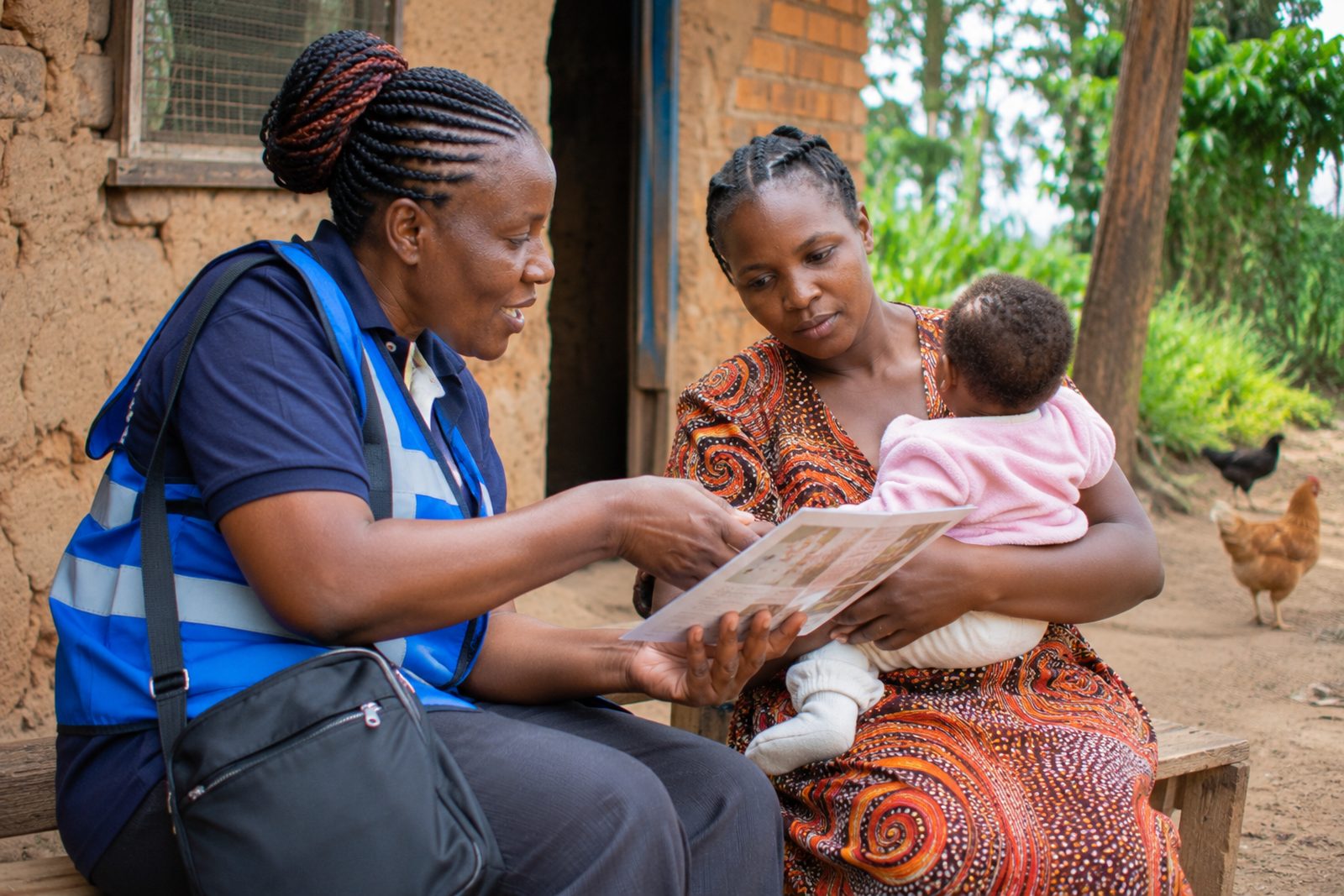
The Ministry of Health describes CHPs as "trained members of the community who work as a link between the community and formal health facilities". They were formerly called community health volunteers.
From the Ministry's community health FAQ (published October 2023):
- A community health unit covers about 5,000 people. It has one community health assistant and ten CHPs, and it is linked to a health facility.
- CHPs are selected by community members in a public baraza.
- Their work includes household visits with health messages, spotting signs of illness and referring people the CHP cannot help, promoting clean water and sanitation, and linking families to the facility.
- At the time, the FAQ said Kenya had about 104,000 CHPs across the 47 counties.
Two more facts matter for AI:
- eCHIS holds household data. The Ministry's privacy policy for the electronic Community Health Information System (eCHIS), in force from 16 November 2022, says CHPs use the app to collect community data, including full names, dates of birth, gender, household member details and disability status.
- Phones came for eCHIS. In October 2023, the Ministry said it was working with Safaricom to give every CHP a smartphone integrated with eCHIS. If your phone was issued for eCHIS, ask your CHA or county whether you may install other apps on it.
In March 2025, the Ministry said the Primary Health Care Act had established primary care networks to improve services at all levels. Ask your county how its rules apply to you.
Why household data stays out
Under Kenya's Data Protection Act, 2019, health data includes data collected while registering for or receiving health services. Health status, family details and the names of a person's children are all sensitive personal data. The data commissioner's Guidance Note on the Processing of Health Data (December 2023) lists community health volunteers and the Community Health Information System among the people and systems that handle health data.
A free chatbot is not eCHIS. What you type there leaves your control. In a village, even "the pregnant teenager near the borehole" can identify someone. So the rule is simple: if it is about a real household, it does not go in.
Six ways CHPs can use AI on a phone
Use any free AI app your county or NGO allows. Free versions have limits that change. Many let you speak instead of type, which helps if typing on a small screen is slow. Each prompt follows the four Cs we teach at FuKazee: Clarity, Context, Constraints and Customisation.
1. Prepare a health talk from approved messages
Clarity: Help me prepare a 10-minute health talk for a women's group. Context: I am a community health promoter in [county], Kenya. The topic is [topic, for example handwashing or why antenatal visits matter]. Constraints: use only the key messages below, which come from my training. Do not add medical advice, medicines or numbers. Customisation: simple Kiswahili, short sentences, three questions to ask the group, and one story-style example with no real names. KEY MESSAGES: [type or paste the approved messages]
Check: every point matches your training materials. If unsure, ask your CHA before the talk.
2. Translate a message into a local language
Translate this approved message into [Kiswahili / Dholuo / Kikuyu / another language] the way people in [area] speak. Keep the meaning exactly the same. Do not add anything. MESSAGE: [paste]
Check: AI translation into Kenyan languages can be stiff or wrong, especially for languages with less online text. Ask a fluent speaker from the community to read it. For why, see who is building AI for African languages.
3. Write minutes for a community meeting
Take out household and patient names before you speak or paste your notes.
Turn my voice notes into short minutes for a community health committee meeting. Headings: date, attendance (numbers only), issues raised, decisions, who does what by when. Do not include names of any household or patient discussed. NOTES: [speak or paste your notes]
Check: read the minutes back before sharing. Remove anything that points to a household.
4. Turn monthly totals into a short report
AI works well with numbers that cannot point to anyone.
Using only these totals for [month], write a half-page report for my community health assistant: households visited [number], health talks held [number], referrals made [number], main issues seen [for example, many homes without a latrine]. Plain English. Suggest two follow-up actions for next month. Do not invent any numbers.
Check: the numbers match eCHIS and your register exactly. Your official reporting still goes through eCHIS and your county's system.
5. Announce a community event
Write a short WhatsApp message and a 30-second announcement for church or the chief's baraza about [event, for example an immunisation outreach]. Date, time and place: [copy exactly from the facility's notice]. Simple Kiswahili and English. Warm and clear, under 80 words each.
Check: the date, time and place are copied exactly. Your link facility confirms before you share.
6. Revise what you learned in training
I am a CHP revising my training on [topic, for example danger signs in newborns]. Here are my notes: [paste your notes]. Ask me eight questions, one at a time, based only on my notes. Tell me where I got it wrong.
Check: your training manual and your CHA are the authority. If AI says something that is not in your manual, trust the manual and ask your CHA.
What CHPs should not do with AI
- No decisions about illness or referral. Follow your training and the protocols in eCHIS. When in doubt, refer to the link facility. Never ask a chatbot whether someone needs to go.
- No medicine advice. AI must not tell a household what to take or how much.
- No household data in public tools. Names, phone numbers, ID numbers, health conditions, HIV or pregnancy status and photos of people or homes all stay out.
- No copying eCHIS data into chatbots. Not even "just to tidy it".
- No AI answers read out as health advice. If a household asks a question you cannot answer, write it down and ask your CHA.
- No photos of households on social media to promote your work, unless your county or NGO has a consent process for it.
For health workers at the facility end, share how nurses can use AI safely.
How FuKazee trains health and community teams
FuKazee trains hospital, clinic and health NGO staff to use AI on the paperwork around care, never on clinical decisions. As our AI training for healthcare page explains, every exercise uses made-up patients or fully masked records, and training runs at your facility anywhere in Kenya by arrangement, or live online. NGOs supporting community health work can also see our AI training for NGOs, which uses free and low-cost tools first and mobile-friendly workflows for field teams. We are AI trainers, not health workers, so your county or programme lead sets the limits.
Questions people ask
Can a CHP use ChatGPT or Gemini on a phone?
Yes, for tasks with no household information, such as preparing a talk, translating an approved message or writing up totals, if your county or programme allows it. If your phone was issued for eCHIS, ask your CHA before installing other apps.
Can AI tell me if a child's symptoms are serious?
Do not use it that way. AI can be wrong and still sound confident. Your training tells you which signs need referral, and the link facility makes the clinical decision. If you are unsure, refer.
Will AI replace eCHIS?
No. eCHIS is the Ministry's system for recording household data and reporting. A free AI app is a writing helper only, and it should never hold household records.
Is AI good in Kiswahili and local languages?
It can be useful in Kiswahili, but it makes mistakes, and it is often weaker in other Kenyan languages. Always have a fluent speaker from your community check a message before you share it.
Where can a CHP learn to use AI for free?
Start with the free courses listed in our guide to free AI courses in Kenya, then practise with prompts like the ones above. Ask your CHA or NGO whether they plan any training.
Sources
All sources last checked 15 November 2026.
- Ministry of Health, Community health services frequently asked questions (October 2023): who CHPs are, community health units, selection and duties, CHP numbers at the time.
- Ministry of Health, Privacy Policy for the electronic Community Health Information System (eCHIS): commencement date and data collected.
- Ministry of Health, "Digital Health Solutions Advancing Healthcare in Kenya" (30 October 2023): smartphones integrated with eCHIS.
- Ministry of Health, "Kenya Strengthens Primary Health Care for Universal Health Coverage" (March 2025): primary care networks under the Primary Health Care Act.
- The Data Protection Act, No. 24 of 2019, ODPC copy: section 2 (health data; sensitive personal data).
- ODPC, Guidance Note on the Processing of Health Data (December 2023).
- FuKazee facts: AI training for healthcare in Kenya and AI training for NGOs in Kenya.
Where FuKazee fits in
FuKazee is a Nairobi training company that has trained more than 3,000 people since 2022. We train health and community teams to use free AI tools on real work, with masked data and clear rules on who decides. If your county or NGO supports CHPs and wants practical training, tell us how many people and where they work. Email lead@fukazee.com
Want guided support instead?
Not sure which programme fits? Tell us who you are and we will point you to the right path: corporate AI training, the ScholarShift Accelerator for postgraduates, or KCSE study plans and tuition.
Rodney has run FuKazee's training since 2022 and still teaches inside every programme line: corporate sessions, the postgraduate cohort and the KCSE examiner webinars. First Class Honours in Journalism and Mass Communication, University of Nairobi.