On this page
AI training for 200 people works in phases, not as one big event. Leaders and line managers go first, then staff learn in groups of about 20, grouped by the kind of work they do and booked around your busy periods. A few trained champions keep it going afterwards, and you measure real tasks before and after.
TL;DR:
- Plan for about ten to twelve groups, not one hall. Groups of about 20 let everyone get help during practice.
- Order matters: executives, then line managers, then staff by function, then frontline and shift staff.
- Book sessions around month-end, shifts and peak seasons, and train branches live online where travel makes no sense.
- Choose two or three champions with protected time before the last group finishes.
- Measure time and quality on two or three real tasks per team, at the start and again after 30 and 90 days.
Why 200 people cannot be trained like 20
At 20 staff, one good workshop can reach everyone. At 200, you have departments with different data, branches on different shifts and managers who will each read the rules differently. The training job turns into a scheduling and coordination job.
If you are planning the wider AI programme as well (pilots, licences, policy), read our AI rollout plan for companies with 100+ staff. This post covers the training part only.
The plan in seven steps
- Agree what AI should do for each team. Before any session, the sponsor lists the work each department wants help with: reports, customer letters, minutes, tenders, analysis. No list, no training plan.
- Set the data rule first. Staff need to know what never goes into a public AI tool before they practise. Kenya's Data Protection Act, 2019 applies to staff and customer records, and the Office of the Data Protection Commissioner (ODPC) enforces it. Train on masked examples.
- Brief the executive team. One short session on direction, risk and what they will ask of managers. Staff watch what leaders do.
- Train line managers next. Managers decide whether their teams get time to practise. If they are not convinced, the training fades within weeks. Our piece on getting middle managers to use AI explains why.
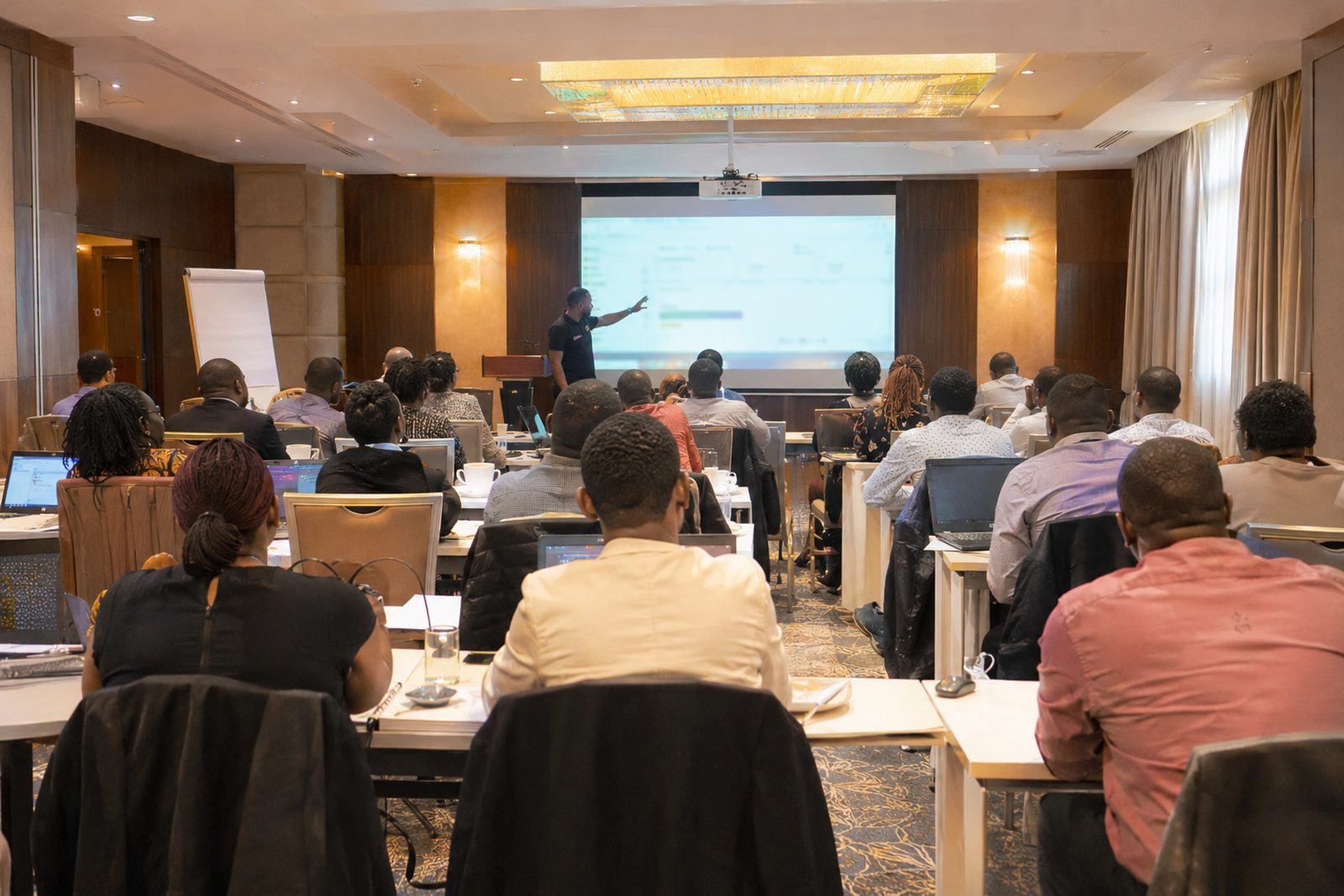
- Run staff groups of about 20, by type of work. Finance with finance, sales with sales. People practise on their own documents, so examples must match their desk.
- Name champions. Pick two or three people who already do good AI-assisted work, and get their managers to agree protected hours each week. Our champions programme guide covers how to choose and support them.
- Measure and follow up. Check the same tasks at 30 and 90 days, and run a short refresher where use has dropped.
Worked example: 200 people on a calendar
This is a worked example with made-up numbers, not a real client. It only shows the arithmetic. Your own numbers will differ.
| Group | Staff | Plan | Groups |
|---|---|---|---|
| Executive team | 10 | One short session on direction and rules | 1 |
| Line managers | 25 | Before their teams start | 2 |
| Head office, by function | 100 | Groups of about 20 | 5 |
| Branch staff in other counties | 40 | Live online, timed around opening hours | 2 |
| Drivers, warehouse and field staff | 25 | Short sessions on safe use and phone tasks | 2 |
| Total | 200 | 12 groups |
In this worked example, if each group had two half-day sessions, that is 24 half-days of training. Spread at two or three half-days a week, it takes about two to three months. That pace also lets each group learn from the questions of the one before.
How to schedule around operations
- Protect month-end for finance and payroll, and peak weeks for sales and customer service.
- Stagger shifts and branches so a counter, a ward or a dispatch desk is never empty.
- Use mornings in Nairobi. Half-days that end before the evening traffic make it easier for people to attend.
- Go online for distant branches. A live online group saves travel days, as long as people have a laptop and a stable connection.
- Ask managers to cover the work. If staff answer email during the session, they learn little.
How do you know the training worked?
Measure whether work changed, not how many people logged in.
| Measure | How to check |
|---|---|
| Use | Share of trained staff who used AI on a real task in the last two weeks |
| Time | Task time, including checking and corrections, against the baseline |
| Quality | A manager reviews a small sample of AI-assisted outputs |
| Risk | Near misses and data questions reported |
Record the baseline before the first group starts. For how to turn this into a return-on-investment case, read how to evaluate ROI on AI training.
How FuKazee would approach a team this size
All facts below come from our live pages, checked on 14 November 2026. They describe how we work with any organisation. They are not a record of a 200-person engagement.
- We start with a discovery call with leadership or the sponsor, then adapt the modules, exercises and examples to how your organisation works (AI training in Kenya).
- We plan around groups of up to about 20, so everyone gets help during practice (AI training in Nairobi).
- Some organisations start with awareness training for everyone, then go deeper with functions such as HR, operations, finance, communications or IT.
- Managers can have their own sessions. Our AI training for managers page is for supervisors, branch heads and team leaders, and says we can stagger groups so a branch or shift stays covered.
- Delivery is on-site, across branches, online or hybrid. The full seven-module programme usually runs over two to four weeks, often in half-day sessions, and any module can run on its own.
- We leave champions behind. Our in-house vs external page explains why most organisations do best with an external kick-off that builds internal champions.
- Participants keep prompt libraries, AI policy guidance and recordings, and we check in afterwards.
We believe this is the best way for a large Kenyan team to learn AI, because people practise on their own work and our founder, Rodney Maina, leads the corporate sessions himself (trainer profile). FuKazee has trained more than 3,000 people since 2022 and more than 20 organisations and institutions. Named work includes three-day programmes for two A.O. Bayusuf and Sons teams in Mombasa in October 2026. We are rated 4.9 from 38 Google reviews, as shown on our reviews page on 14 November 2026.
To be clear: the engagements named on our site are team-sized, and none of them is a 200-person programme. Ask us which past work is closest to your size, and ask whether you can speak to that client before you sign.
When FuKazee may not be the right fit
- You need all 200 people trained in the same week at several sites. Our founder leads the sessions himself, so groups usually run one after another.
- You want a self-paced e-learning platform. Our corporate training is live, on-site or online.
- You need NITA-accredited training. FuKazee is not yet NITA accredited. Ask us for the current status.
- You need software built or licences sold. We do not sell software.
Questions people ask
How long does it take to train 200 staff on AI?
It depends on how many sessions each group gets and how often you can release people. In the worked example above (made-up numbers), 12 groups with two half-days each would take about two to three months.
Should everyone get the same training?
No. Everyone needs the same basics and data rules. After that, finance, sales and operations need examples from their own work.
Can branch staff join online?
Yes. Live online groups work well for branches, as long as each person has a device and a stable connection.
How many champions does a 200-person company need?
Start with two or three people whose managers agree to protected hours. Add more if one champion cannot reach their area.
Do we need paid AI licences before training?
No. Good training shows the free version of each tool first. It then helps you judge who needs a paid seat.
Sources
All sources last checked 14 November 2026.
- FuKazee, AI training in Kenya: process, delivery formats, programme length, awareness-first option, what participants keep, 3,000+ people trained, 20+ organisations.
- FuKazee, AI training in Nairobi: groups of up to about 20; Data Protection Act and ODPC.
- FuKazee, AI training for managers: for supervisors, branch heads and team leaders; staggered groups so a branch or shift stays covered.
- FuKazee, In-house vs external AI training: external kick-off that leaves champions behind; two or three champions with protected time; half-days over two to four weeks.
- FuKazee, Rodney Maina trainer profile: A.O. Bayusuf and Sons engagement; Rodney leads corporate sessions.
- FuKazee, Reviews and letters: 4.9 from 38 Google reviews.
- Office of the Data Protection Commissioner: mandate under the Data Protection Act, 2019.
Where FuKazee fits in
FuKazee trains Kenyan teams to use AI on the work already on their desks, in groups small enough for real practice, with managers first and champions left behind.
Not sure where to start? Take the free three-minute AI readiness assessment, or see our vendor information for procurement.
To plan training for your 200 staff, tell us what you want AI to do for each team, how many people, and when. Email lead@fukazee.com
Want guided support instead?
Plan AI training around your team's real work. Answer a few quick questions about your sector, team size and goals, and we will recommend the right programme and format. Sessions are built on your workflows and include a usage policy.
Rodney has run FuKazee's training since 2022 and still teaches inside every programme line: corporate sessions, the postgraduate cohort and the KCSE examiner webinars. First Class Honours in Journalism and Mass Communication, University of Nairobi.