On this page
Microfinance field officers can use AI on their phone to turn rough visit notes into clean reports, summarise group meetings, and explain loan terms in plain English and Kiswahili. You speak or type what you saw and heard, and AI organises it. AI never decides who gets a loan, and borrowers' names, ID numbers and phone numbers stay out of public AI tools.
TL;DR:
- Start with the writing that eats your evenings: visit notes, group meeting summaries and reminder messages.
- Use voice typing on your phone, then let AI tidy the words into your lender's format.
- Build every loan explanation from your lender's approved terms, then have a fluent Kiswahili speaker check the translation.
- AI does not approve, decline or score loans. Your credit process and the people in it do.
- Replace names with labels such as "Member A" before anything goes into a public tool.
Who this guide is for
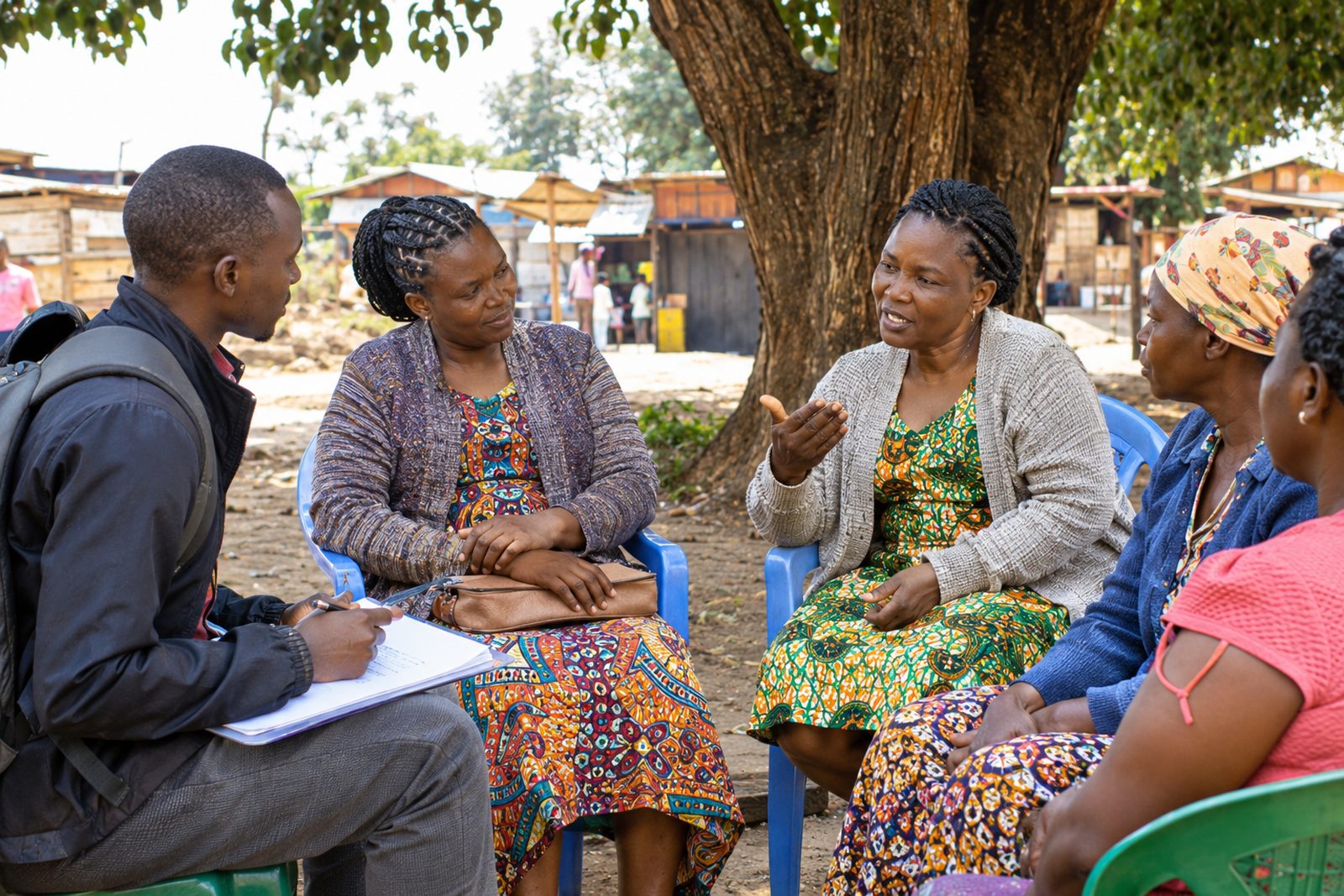
This guide is for field officers, credit officers and group lending officers at microfinance banks, credit-only lenders and other microlenders in Kenya. Most of your day happens away from a desk: in markets, at business premises and under trees at group meetings. So everything below works on a phone.
If you work at a SACCO, read our guide on how SACCO loan officers can use AI, which covers SACCO rules. If you have not chosen an app yet, see our comparison of free AI apps for your phone in Kenya. Free versions have limits that change.
The rules that shape your work
Two sets of rules matter most. Your compliance officer confirms which apply to your lender.
Who regulates your lender. The Central Bank of Kenya (CBK) licenses and supervises microfinance banks under the Microfinance Act, 2006, which came into force on 2 May 2008. The CBK splits them into community-based and nationwide microfinance banks. Lenders that give credit without taking deposits are different. The CBK has licensed digital credit providers since the CBK Act was changed in 2021. A CBK regulatory impact statement explains that the Business Laws (Amendment) Act, 2024 widened those rules and renamed these lenders "non-deposit taking credit providers". The CBK (Non-Deposit Taking Credit Providers) Regulations, 2026 were then published on 29 September 2026 as Legal Notice 191 of 2026. Law firm summaries say regulation 60 covers lenders that use AI in credit decisions: those decisions must be explainable, and people must oversee them. Parts of these regulations were being questioned in Parliament in November 2026, so ask your compliance officer what applies to your lender today.
A draft to watch. In April 2026, Kenya's financial regulators, including the CBK, asked the public to comment on a draft Financial Consumer Protection Framework, dated March 2026. As of 15 November 2026, we found it on the CBK website as a draft, so it is not yet in force. Two parts matter to field officers:
- It would require lenders to explain the benefits, features, risks, terms and costs of a product in plain language before a customer signs a credit contract.
- Its debt collection section would ban shaming, including announcing a person's debt "at a community forum or place of worship or other public premises".
Data protection. Borrower files hold personal data. Under the Data Protection Act, 2019, property details and family details, including the names of a person's children and spouse, count as sensitive personal data. Section 25 also says that information about family or private affairs should be collected only with a valid explanation. Visit notes often hold exactly this kind of information.
Five tasks where AI helps field officers
Each prompt uses the four Cs we teach at FuKazee: Clarity (what you want), Context (your situation), Constraints (the rules) and Customisation (who will read it). Replace the square brackets. Use labels, never real names, ID numbers or phone numbers.
1. Turn rough visit notes into a clean report
After a business visit, open voice typing and speak your notes as you walk to the next client. Then paste them in.
Clarity: turn my rough notes from a business visit into a visit report. Context: I am a microfinance field officer in Kenya. The client is "Client A", who runs [type of business] in [area]. Constraints: use only what is in my notes. Use these headings: business seen, stock and activity observed, what the client told me, concerns, follow-up needed. Where something is missing, write [NOT RECORDED]. Do not give an opinion on whether to lend. Customisation: short sentences my branch manager can read in one minute. NOTES: [paste]
Check: every figure and observation matches what you actually saw. Delete anything AI added. Copy the final text into your lender's own system.
2. Summarise a group meeting
Turn these notes from a group lending meeting into a short summary. Context: the group is "Group 7", meeting weekly in [area]. Include: attendance (as numbers only), repayments reported as collected, issues raised, decisions the group made, and actions with who is responsible (use member labels such as M1, M2). Constraints: under 200 words. Do not name anyone who is behind on payments. Do not add anything that is not in my notes. NOTES: [paste]
Check: repayment figures match your collection records exactly. The summary should never single out a member who is behind, both for respect and because the draft framework would treat public shaming as unacceptable.
3. Explain loan terms in plain English and Kiswahili
Using only the approved product terms below, explain this loan to a first-time borrower who runs a small business. Cover: how much they borrow, how much they repay in total, how often they pay, what happens if they pay late, and who to call with questions. Under 150 words of simple English, then the same in natural Kiswahili. Do not change any number, fee or date. If the terms do not say something, write [ASK THE BRANCH]. TERMS: [paste your lender's approved product sheet]
Check: compare every number with the product sheet. A fluent Kiswahili speaker at your branch reads the translation, because AI Kiswahili can sound stiff or shift a meaning. Our guide to who is building AI for African languages explains why. Your manager approves the final wording before you use it.
4. Prepare for a group training session
Plan a 20-minute talk for a women's self-help group in [county] on [topic, for example keeping simple business records]. Include: one short story to open (clearly fictional), three key points, one activity they can do with a pen and paper, and three questions to check understanding. Simple English with Kiswahili phrases. No product promotion. No promises about loans.
Check: the advice fits your lender's products and policies. Remove anything that sounds like a sales pitch.
5. Write respectful reminder messages
Write three short SMS reminders for a borrower whose repayment is due on [date]. Message 1: friendly, three days before. Message 2: on the due day. Message 3: two days late, asking them to call me to agree a plan. Each under 160 characters, in Kiswahili and English. No threats, no shaming, nothing about telling the group or family, and no false statements about what will happen.
Check: the messages match your lender's collection policy and approved templates. Send them only through your lender's approved channel.
What AI must not do in microfinance
- Decide credit. AI should not approve, decline, score or rank applicants. Section 35 of the Data Protection Act gives people the right, with some exceptions, not to be subject to a decision based solely on automated processing that significantly affects them. Your credit process sets who decides.
- Hold real borrower data in a public tool. Names, ID numbers, phone numbers, M-PESA statements, photos of homes or businesses, and guarantor details stay out. Section 25 also says personal data should not leave Kenya without proof of adequate safeguards or the person's consent, and most public AI tools run abroad.
- Check credit history. Credit reports come from licensed credit reference bureaus, which the CBK licenses and supervises, through your lender's own process.
- Invent product terms. Every rate, fee and penalty comes from your lender's approved documents.
- Send anything unchecked. You own every message you send, whoever drafted it.
For the basics, read our guide to the Data Protection Act and AI at work.
How FuKazee trains finance teams
FuKazee trains credit, member service and field teams to use AI on their real paperwork, with invented or masked customers throughout. As our AI training for SACCOs page explains, microfinance teams work under different rules from SACCOs, but the habits of masking and checking carry over, and your compliance officer confirms what applies. Head office can train on-site by arrangement, with branches joining live online so field work continues. We show the free version of every feature first, and Copilot for teams already on Microsoft 365. Banks and larger lenders can see our AI training for banks and financial services.
Questions people ask
Can a field officer use ChatGPT on a personal phone for work?
Only if your employer allows it, and only with masked details. Ask your manager or data protection officer first. Many lenders have rules about personal phones and client information.
Can AI decide whether a client can repay?
No. AI can tidy the figures you have already checked into a clear write-up. Judging repayment ability is the job of the officer and the approval process your lender has set.
Is AI good enough at Kiswahili for loan explanations?
It gives a useful first draft. A fluent speaker must check it every time, because one wrong word in a loan explanation can mislead a borrower about what they owe.
Can I take photos of a client's business and ask AI about them?
Avoid it in public tools. Photos can show faces, number plates, signs and locations that identify the client. Keep photos in your lender's approved system.
Sources
All sources last checked 15 November 2026.
- Central Bank of Kenya, Bank Supervision: licensing of microfinance banks, the Microfinance Act, 2006 (operational from 2 May 2008), the two categories of microfinance bank, and licensing of credit reference bureaus.
- Central Bank of Kenya, Regulatory Impact Statement on the CBK (Non-Deposit Taking Credit Providers) Regulations, 2026, May 2026 (PDF): the 2021 change that brought digital credit providers under the CBK, and the Business Laws (Amendment) Act, 2024.
- The Central Bank of Kenya (Non-Deposit Taking Credit Providers) Regulations, 2026, Legal Notice 191 of 2026, Kenya Law: published 29 September 2026.
- MMS Advocates, "The Central Bank of Kenya (Non-Deposit Taking Credit Providers) Regulations, 2026" (5 November 2026): in force on publication; regulation 60 on AI in lending.
- Kahawatungu, "MPs Order CBK to Halt Rollout of Proposed Credit Provider Regulations" (13 November 2026): parliamentary committee review.
- Central Bank of Kenya, public notice inviting comments on the draft Financial Consumer Protection Framework and the draft framework, March 2026 (PDF): sections 2.3.11 (debt collection) and 2.4.2 (explanations for consumers).
- The Data Protection Act, No. 24 of 2019, ODPC copy (PDF): section 2 (sensitive personal data), section 25 (principles) and section 35 (automated decisions).
- FuKazee facts: AI training for SACCOs in Kenya.
Where FuKazee fits in
FuKazee is a Nairobi training company that has trained more than 3,000 people since 2022. We assume nobody in the room knows AI, we avoid jargon, and we say plainly that nobody becomes an expert in a few days. We are AI trainers, not credit experts, so your lender's policies set the limits. Tell us how many field officers you have, where they work and what you want AI to help with. Email lead@fukazee.com
Want guided support instead?
Plan AI training around your team's real work. Answer a few quick questions about your sector, team size and goals, and we will recommend the right programme and format. Sessions are built on your workflows and include a usage policy.
Rodney has run FuKazee's training since 2022 and still teaches inside every programme line: corporate sessions, the postgraduate cohort and the KCSE examiner webinars. First Class Honours in Journalism and Mass Communication, University of Nairobi.